
In modern SharePoint Online sites, the Button web part is one of the simplest ways to create a clear call to action that directs users to an important link with a single click. This tutorial explains what the SharePoint Online Button web part is, when to use it, and how to configure label, link, and alignment with a real‑time intranet example.
Recently, an intranet portal was designed for a client who wanted employees to report IT issues quickly, without having to hunt through multiple pages. To achieve this, a Button web part labeled Raise a Ticket was added to the SharePoint Online home page and linked directly to the IT support form.
- When users click the button, they are redirected straight to a support form where they can submit their issue details.
- This approach reduces friction, improves user experience, and makes the home page a central place for critical actions like incident reporting.
Using a SharePoint Online Button web part for such actions ensures that important links are not buried inside menus, but are always visible as a prominent call to action.
What is the SharePoint Online Button Web Part?
The SharePoint Online Button web part is a modern web part that allows you to add a single clickable button with a custom label and URL on a modern page. It is available in SharePoint in Microsoft 365 on modern pages and is not supported in classic pages or SharePoint Server 2019.
- You can define a custom label (for example, “Raise a Ticket”, “Submit Request”, “View Policy”, or “Apply Now”).
- You can configure the click action by adding an internal SharePoint URL, an external URL, or even a mailto link, depending on your requirement.
The button automatically adopts the color from the current SharePoint site theme, keeping your design consistent without requiring custom CSS in most cases.
When Should You Use a Button Web Part?
The Button web part is ideal for highlighting a single important action on a SharePoint modern page. For example, you can use it in the following situations:
- IT support or helpdesk actions such as Raise a Ticket, Log a Service Request, or Report an Issue.
- HR or employee self‑service actions such as Apply for Leave, Update Personal Details, or Access HR Policies.
- Business processes such as Create New Request, Start Workflow, or Open Power Apps form.
If you need multiple links with different icons and layouts, consider using the Quick Links web part; but if you have one primary call to action in a section, the Button web part keeps the focus on that single action.
Check out SharePoint Image Gallery Web Part
Example Layout: Text Web Part + Button Web Part
In the intranet scenario, a Text web part is used first to provide context about the IT Support section, followed by the Button web part. This helps employees understand what the section is about and what will happen when they click the button.
A typical layout could look like this:
- A heading like “IT Support” created using the Text web part.
- A short explanatory paragraph, for example: “Having an IT issue? Use the button below to raise a support ticket.”
- A Button web part labeled Raise a Ticket, aligned as per your design (left, center, or right) and pointing to the support form URL.
This combination of context and a button improves usability and drives more clicks than a standalone button without explanation.
Read SharePoint Online Code Snippet Web Part
How to Add a SharePoint Online Button Web Part
Follow these steps to add the Button web part to a SharePoint Online modern page.
1. Edit the SharePoint modern page
- Open the SharePoint Online site and navigate to the modern page where you want to insert the Button web part.
- Select Edit at the top‑right corner of the page to switch to edit mode.
2. Insert the Button web part
- Hover your mouse above or below an existing web part until you see a horizontal line with a circled + icon.
- Click the + icon to open the web part gallery and search for Button.
- Select the Button web part; it will be added to the selected section or column of the page.

In your example, the Button web part was added just below the Text web part that describes the IT support section, so the context and call to action appear together.

3. Open the Button web part properties
- Select the Button web part on the page.
- Click the Edit web part icon (pencil icon) to open the property pane on the right side.
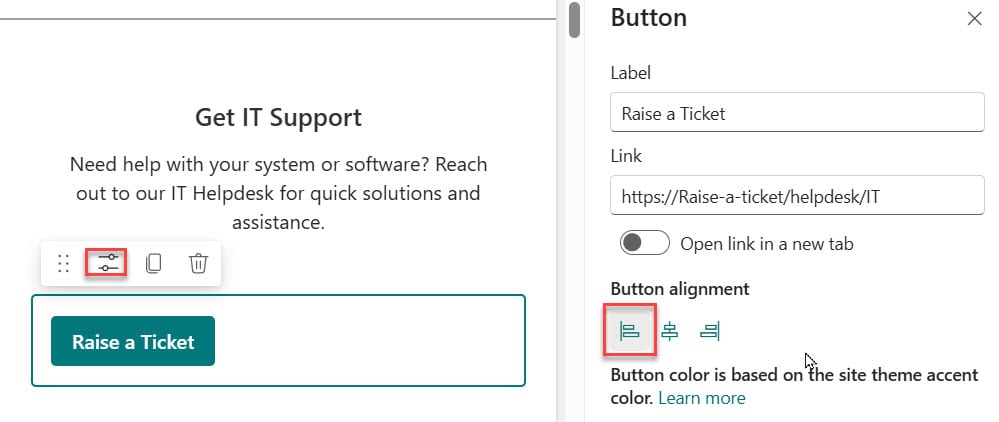
Here you can configure the label, the link, whether to open in a new tab, and the button alignment.
Check out Create an Org Chart in SharePoint Online using Organization Chart Web Part
How to Configure Label and Link in the Button Web Part
After adding the Button web part, configure the text displayed on the button and the destination URL for the click.
Configure the button label
- In the property pane, locate the Label field.
- Enter the text you want to show on the button, for example: Raise a Ticket, Submit IT Request, or Log an Issue.
Choose a short, action‑oriented label so users know exactly what will happen when they click. In the example, the label is set to “Raise a Ticket”, which clearly describes the action.

Configure the button link
- In the Link field, paste the URL where you want the user to be redirected when they click the button.
- This could be:
- A SharePoint list form URL for logging incidents.
- A Power Apps or Power Automate form URL.
- An external service desk tool like ServiceNow or Zendesk.
Ensure the link starts with http://, https://, or mailto:; if you enter a URL without a protocol, SharePoint automatically prepends https://.
Open the link in a new tab
If you want the support form or target page to open in a new browser tab:
- In the property pane, turn on the toggle for Open link in a new tab.
This is useful when the button is on your intranet home page, and you want users to keep the home page open while they complete the form in another tab.
Once these options are configured, you will see the button on the page with the specified label and link.
Check out SharePoint File and Media Web Part
Button alignment options in SharePoint Online Button Web Part
One of the key formatting options for the Button web part is alignment within its column on the modern page. In the properties pane, you can choose how the button is aligned relative to the column content.
Available alignment options
When you edit the Button web part, under Alignment, you will see the following options:
- Left
- Center
- Right
By default, the Button web part is left-aligned, which means the button appears on the left side of the column. Left alignment usually matches the natural reading flow and works well for most forms and content sections.
Left alignment
Left alignment is the default option for the Button web part. This is typically used when:
- The Text web part above the button is also left-aligned.
- The section follows an F‑pattern reading layout, where content flows from left to right.
In your example, when left alignment is selected, the Raise a Ticket button appears on the left under the IT support text. Here is a screenshot for your reference.
Center alignment
Center alignment is a good choice when you want the button to stand out as a primary call to action in a dedicated section. For example:
- On a landing page, a single important action (such as “Register Now”) must be visually prominent.
- Under a hero or banner section, where the layout is visually centered.
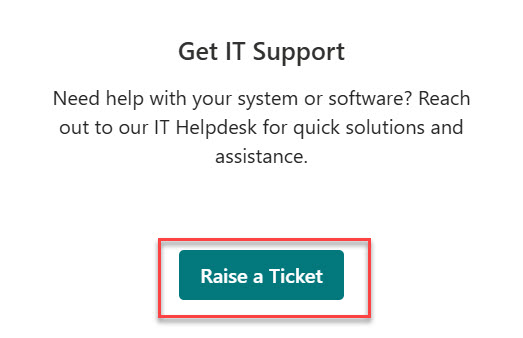
In your article, when the Center is selected, the button is displayed in the middle of the column, making it visually balanced in that section.
Right alignment
Right alignment is useful in layouts where content is right‑aligned or when you want to align multiple elements to the right side of a section. This can work well in:
- Two‑column layouts where the text is in the left column and the button is in the right column.
- Scenarios where the button is part of a group of right‑aligned actions at the bottom of the section.
When you choose Right, the SharePoint button moves to the right side of the column, as shown in your screenshots for that configuration.

Read SharePoint Group Calendar Web Part
Notes about button color and theme
The current SharePoint site theme controls the color of the Button web part. You do not configure the color directly inside the Button web part properties.
- If your site uses a corporate theme, the button automatically matches the primary or accent color, keeping your pages consistent with your branding.
- To change the button color, you typically update or apply a different site theme rather than changing individual buttons.
This approach keeps design consistent and reduces the need for custom CSS or script injection on modern pages.
Conclusion
The SharePoint Online Button web part is a lightweight but powerful option to highlight key actions on modern pages and improve user engagement. By combining it with a Text web part, configuring a clear label and correct link, and using alignment options effectively, you can create intuitive call‑to‑action sections like Raise a Ticket on your intranet home page.
Used correctly, this web part helps employees quickly reach the forms, processes, and tools they need, without navigating through complex site structures.
You may also like the following tutorials:

After working for more than 18 years in Microsoft technologies like SharePoint, Microsoft 365, and Power Platform (Power Apps, Power Automate, and Power BI), I thought will share my SharePoint expertise knowledge with the world. Our audiences are from the United States, Canada, the United Kingdom, Australia, New Zealand, etc. For my expertise knowledge and SharePoint tutorials, Microsoft has been awarded a Microsoft SharePoint MVP (12 times). I have also worked in companies like HP, TCS, KPIT, etc.

