
Creating an engaging intranet or team collaboration space requires visually appealing content. Recently, I was working with a client to design an attractive home page for their intranet portal. In one section, they wanted to display the team’s event photos on the home page in a visually organized manner.
Microsoft SharePoint Online provides a powerful solution for this requirement: the Image Gallery web part. This web part allows you to display multiple images from a SharePoint document library dynamically, making it easy to keep your content fresh without manual updates.
In this comprehensive tutorial, I will explain how to use the image gallery web part in SharePoint Online, including its various layout options, best practices, and practical implementation strategies.
SharePoint Image Gallery Web Part
The Image Gallery web part is a modern web part designed to showcase collections of images in SharePoint Online. Whether you’re displaying event photos, product galleries, team celebrations, or marketing materials, the Image Gallery web part provides a flexible and professional solution.
Unlike traditional image management approaches, this web part automatically pulls images from your document libraries, keeping your display up-to-date without manual intervention.
Key Features:
- Display images dynamically from document libraries
- Multiple layout options (Grid, Brick, Carousel)
- Customizable aspect ratios and display settings
- Support for subfolders
- Automatic image management
Display Images Dynamically from a Document Library in an Image Gallery Web Part
Step 1: Prepare Your Document Library
Before adding the Image Gallery web part, you’ll need to set up a dedicated document library to store your images. Here’s how:
- Navigate to your SharePoint site
- Go to Site Contents and click + New > Document Library
- Name your library (for example, “Events Photos” or “Gallery Images”)
- Click Create
- Upload your images to this library. You can organize them in subfolders for better management.
In this example, I created a document library called “Events Photos” and uploaded the team’s event photos there. Now, we’ll use the Image Gallery web part to display those images dynamically on our page.
Why This Approach is Better:
Instead of uploading images directly within the Image Gallery web part (which stores them in the Site Assets library), using a dedicated document library offers several advantages:
- Better organization and management
- Easier to share the library with team members for uploads
- More control over permissions and versioning
- Simpler to maintain and update images
- Better for large collections of images
Step 2: Add the Image Gallery Web Part
- Edit the SharePoint page where you want to add the Image Gallery web part
- Click the + (Plus) icon to add a new web part
- Search for Image Gallery
- Click on the Image Gallery web part to add it to your page
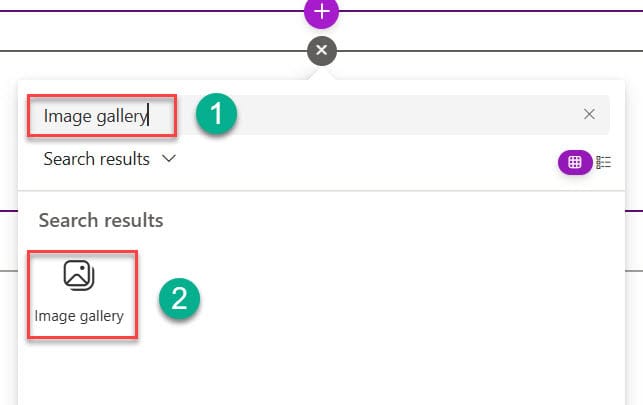
By default, the Image Gallery web part displays options to add or upload images directly. However, we recommend using a dedicated document library instead.
Step 3: Configure the Image Gallery Web Part
To display images from your document library:
- Edit the Image Gallery web part
- In the Image options panel, select “Dynamically display images from a document library”
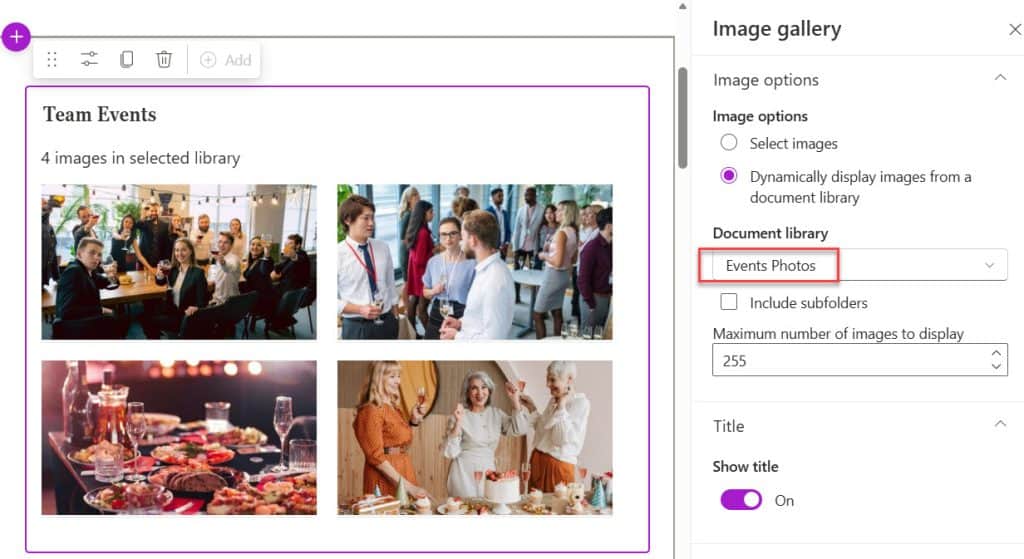
- Choose the document library from which you want to display the photos (e.g., “Events Photos”)
- Configure additional options:
- Include Subfolders: Check this box if you want to display photos from subfolders within your library
- Image Limit: Specify the maximum number of images to display (up to 255)
- Image Filter: Optionally filter images by metadata or file properties
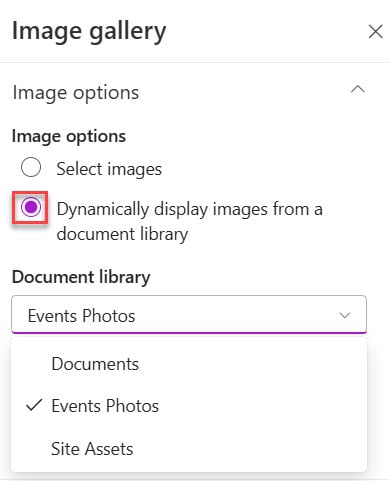
After selecting your document library (such as “Events Photos”), the web part will automatically display all images from that library. If you have organized your photos into subfolders (such as “2026 Events,” “Team Celebrations,” “Product Launches”), you can enable the “Include Subfolders” checkbox to display photos from all these subfolders in a single gallery.
Important Limitation: We can only display up to 255 images in the Image Gallery web part. If you need to display more images, consider using multiple web parts or creating multiple galleries with filtered content.
After I selected “Events Photos”, it displayed the images from the same library, as shown in the screenshot below. If there are subfolders inside the document library, you can select the checkbox (Include Subfolders) to display photos from the subfolders also. Here is a screenshot for reference.
Check out SharePoint Online Code Snippet Web Part
SharePoint Image Gallery Web Part Layout Options
Microsoft provides three distinct layout options for the Image Gallery web part, each serving different purposes and visual styles. Selecting the right layout depends on your content type and intended audience.
1. Grid Layout (Default)
The Grid layout is the most common and versatile option, displaying images in an organized, rectangular grid formation.
Grid Layout Features:
- Clean, professional appearance
- Easy to scan and navigate
- Perfect for event photos and team galleries
- Highly responsive on mobile devices
Aspect Ratio Options:
The Grid layout allows you to choose different image aspect ratios to best display your content:
- 1:1 Square: Perfect for profile photos, product thumbnails, and social media-style galleries. All images are displayed as square tiles, creating a uniform appearance
- 16:9 Wide: Ideal for landscape photos, event photography, and panoramic images. This ratio mimics modern monitor and mobile screen dimensions
- 4:3 Standard: A traditional photo ratio that works well for professional photography and balanced image presentations
Grid Layout Example:
When you choose the Grid layout with the 16:9 Wide aspect ratio, the Image Gallery web part displays images in a wide, landscape-oriented grid. This layout works exceptionally well for event photography, where the wider aspect ratio captures more of the scene and creates an engaging visual experience.

2. Brick Layout
The Brick layout, also known as Masonry layout, displays images in a staggered, brick-like pattern with varying sizes. This layout creates a more dynamic and visually interesting presentation.
Brick Layout Features:
- Creates visual interest with varied image sizes
- More compact display than the Grid layout
- Excellent for showcasing diverse image dimensions
- Pinterest-style appearance
- Great for portfolios and creative galleries
When to Use Brick Layout:
- Portfolio and design showcases
- Mixed-dimension photo collections
- Creative team galleries
- When you want a more artistic, less rigid presentation
Implementation Note:
When you select the Brick layout from the properties panel, the Image Gallery web part automatically arranges your images to fill available space efficiently, creating a cohesive visual experience that draws the viewer’s eye across all images naturally.

3. Carousel Layout
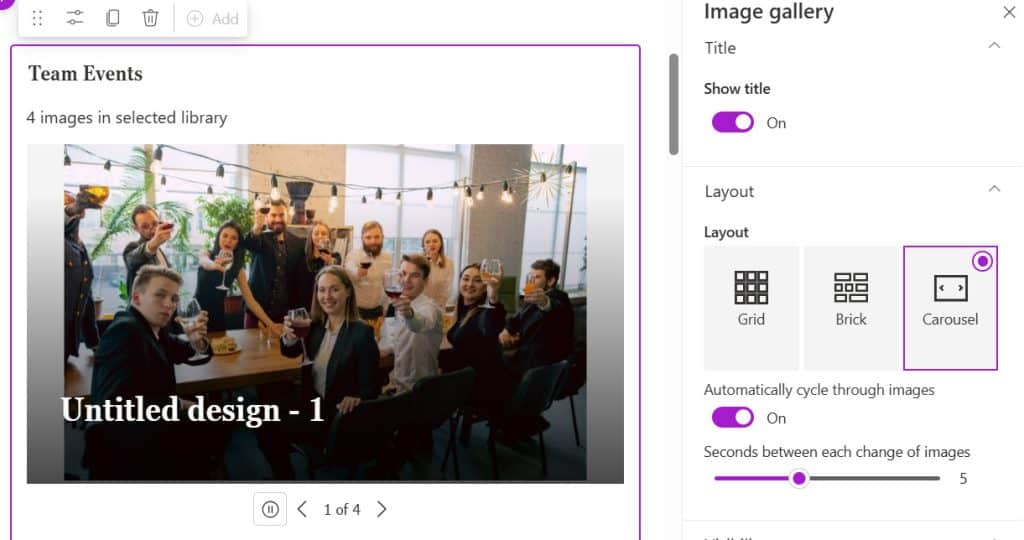
The Carousel layout displays images in a rotating slideshow format, perfect for featured image collections or hero sections.
Carousel Layout Features:
- Displays images one at a time in a slideshow format
- Can be set to cycle automatically
- Navigation arrows for manual browsing
- Ideal for hero sections and featured content
- Engages users with dynamic content
Carousel Configuration:
- Select Carousel from the layout options
- Enable “Automatically cycle through images” toggle if you want automatic rotation
- Select the rotation interval (how many seconds between image changes):
- 2 seconds: Fast-paced presentation
- 5 seconds: Standard presentation
- 10 seconds: Extended viewing time for detailed images
Display Customization:
In the Carousel layout, you can customize the appearance by adding image titles and descriptions. By default, the web part displays metadata such as “Untitled design-1” on each image, which you can configure based on your image properties.
Read Create an Org Chart in SharePoint Online using Organization Chart Web Part
Common Use Cases for Image Gallery Web Part
Now, let me show you some common uses of the SharePoint image gallery web part.
- Event Documentation: Display photos from company events, conferences, or team gatherings
- Product Showcase: Present product images in an attractive gallery format
- Employee Spotlights: Feature team members with professional photos
- Project Portfolios: Showcase completed projects and work samples
- Training Materials: Display visual content for training and onboarding
- Office Spaces: Showcase company culture and workspace aesthetics
- Customer Success Stories: Display customer photos and testimonials
- Community Events: Share photos from community outreach activities
Conclusion
The SharePoint Online Image Gallery web part is an essential tool for creating visually engaging collaboration and communication spaces. Whether you’re displaying event photos, product galleries, team celebrations, or marketing materials, the Image Gallery web part provides a flexible and professional solution that grows with your content.
By following the steps outlined in this guide and leveraging the different layout options, you can create compelling visual experiences that enhance your SharePoint Online sites and keep your audience engaged.
Start implementing the Image Gallery web part today to transform how you showcase images across your SharePoint sites.
You may also like the following tutorials:

After working for more than 18 years in Microsoft technologies like SharePoint, Microsoft 365, and Power Platform (Power Apps, Power Automate, and Power BI), I thought will share my SharePoint expertise knowledge with the world. Our audiences are from the United States, Canada, the United Kingdom, Australia, New Zealand, etc. For my expertise knowledge and SharePoint tutorials, Microsoft has been awarded a Microsoft SharePoint MVP (12 times). I have also worked in companies like HP, TCS, KPIT, etc.

