
In this article, learn how to use the SharePoint Online Quick Chart web part to turn your data into simple column and pie charts directly on modern SharePoint pages. This is especially useful for business users who want quick visualizations without using Power BI or advanced charting tools.
In our organization, an intranet portal was created for the HR department to display important data such as monthly hires and other key metrics. To make this information easier to understand at a glance, the Quick Chart web part was used to display the data as visual charts on the home page
What is the Quick Chart Web Part in SharePoint?
The Quick Chart web part is a modern SharePoint Online web part that allows you to create basic column and pie charts directly on a page. You can either enter data manually or pull it from a list or library on the current site.
It is meant for simple scenarios where you want to show a small number of key values visually, not for complex reporting or advanced analytics (for those scenarios, Power BI or other tools are recommended).
When to use Quick Chart Web Part in SharePoint
Here are a few practical scenarios where the Quick Chart web part works very well:
- Monthly hires, attrition, or training completion counts for HR.
- Number of projects per department or budget per project.
- Tickets resolved per category or priority in a support team.
- Simple sales or revenue breakdowns by region or product line.
Use it when you want a quick, configurable visualization that anyone visiting the page can understand in a few clicks.
Prerequisites and limitations
Before configuring Quick Chart, keep these points in mind:
- The page must be a modern SharePoint Online page; Quick Chart is not available on classic pages.
- You need Edit permissions on the page to add or configure the web part.
- Only two chart types are available: Column and Pie.
- When entering data manually, you can add up to 12 data label and value pairs.
- When using list data, you must have at least one Number column in the list or library.
Understanding these limits helps you decide whether Quick Chart is the right choice for your scenario.
Check out SharePoint Group Calendar Web Part
Add SharePoint Online Quick Chart Web Part
Here, I will show you how to add the SharePoint Online Quick Charts web part. Please follow the instructions below.
- Open your SharePoint Online site and navigate to the page where you want to display the chart. Click Edit in the top‑right corner of the page.
- In the section where you want the chart, click the + icon to add a new web part. Then the Search box will appear, and you can search for Quick Chart. Then you will find the Quick Chart web part as shown in the screenshot. Then click on the Quick Chart web part.

- Select the Quick Chart web part from the list. The Quick Chart web part will be added to the page with a default configuration. We can also add a Name to the Quick chart web part.

Once we have added the SharePoint Online Quick chart web part, we need to configure it.
Chart Types in Quick Chart Web Part
The Quick Chart web part supports two chart types: Column and Pie.
Column chart
- Best for comparing values across categories (e.g., hires per month, budget per project).
- Displays labels on the horizontal axis and values on the vertical axis.
- When using list data, you can sort values in ascending or descending order.
Pie chart
- Best when you want to show proportions of a whole with a small number of categories (Microsoft recommends fewer than seven categories for readability).
- Displays each category as a slice with percentage values.
- Layout options, such as horizontal and vertical axis labels, are not available for pie charts.
Read SharePoint People Web Part
How to Select the Chart Type
Here are the steps to choose the chart type in the SharePoint Online Quick Chart web part.
- Edit the page and then select the Quick Chart web part. In the web part property pane on the right, locate Chart type. Choose Column chart or Pie chart from the dropdown.
- Here, by default, a Column chart is displayed, showing the data changes. In this chart, we can mention the labels on the horizontal axis and Values on the vertical axis under the Layout option

- If you select Pie chart, then the SharePoint Online Quick chart web part is displayed as shown in the screenshot. This chart is best when we use fewer than seven categories. And here it displays the percentages of the whole, and the layout option is not available in this chart.

Enter Data Manually in Quick Chart Web Part
The first way to use Quick Chart is by entering data directly into the web part. This is useful when you have a small set of values that do not need to be maintained in a SharePoint list.
- Edit the page and select the Quick Chart web part. In the properties pane, under Data, choose Enter data. This option is usually selected by default.
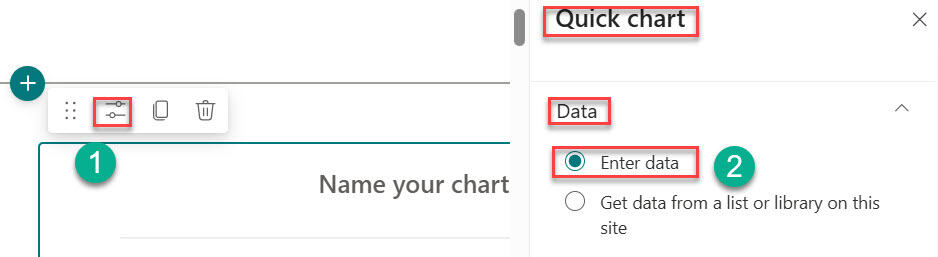
- You will see a simple grid with Data label and Value columns. Enter your labels (for example, Jan, Feb, Mar, Apr) and corresponding values (for example, 5, 8, 6, 9). Click + Add to add more rows. You can add up to 12 label/value pairs. As you type, the chart updates instantly on the page to reflect your data

- In the same web part pane, expand the Layout section. For a Column chart, enter a Horizontal axis name (for example, “Month”) and a Vertical axis name (for example, “Number of Hires”). These labels appear along the axes, making the chart easier for users to understand at a glance.
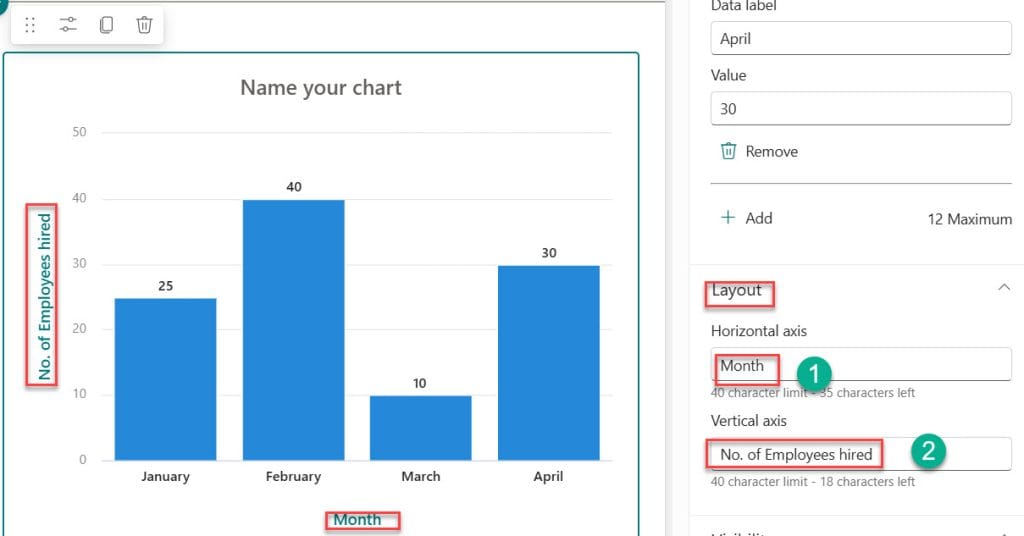
Using manual data is perfect when you need a quick visualization that rarely changes or for demos and mockups.
Display Data from a SharePoint list or library in Quick Chart
The second and more powerful option is to connect the Quick Chart web part to an existing SharePoint list or library on the current SharePoint site. This allows the chart to update automatically as list data changes.
Prepare your list
To use list data, you need at least:
- One Number column (for values).
- One Text or other label column (for category labels, for example, Month, Department, Project Name).
Example: Create a SharePoint list named Project Tracker with the following columns:
- Project Name – Single line of text.
- Budget – Number.
Connect Quick Chart to a SharePoint list
- Edit the page and select the Quick Chart web part.
- In the properties pane, under Data, choose Get data from a list or library on this site.
- From the dropdown, select the list or library that contains your data (for example, Project Tracker). The list must contain at least one Number column.
- Next, choose the column that holds the data to display (for example, Budget).
- Then choose the column that will provide the labels (for example, Project Name).
Here is a screenshot for your refernece.

Sorting list data in the chart (Column chart)
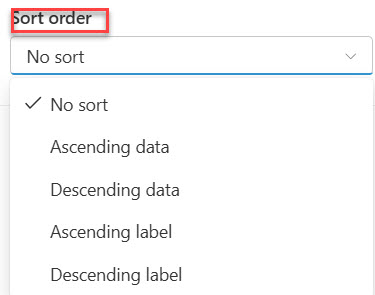
- When you use a Column chart with SharePoint list data, an additional Sort order option appears.
- In the properties pane, under Sort order, choose Ascending or Descending
- Sorting applies to the values so that your chart can display bars from lowest to highest or highest to lowest.
- For example, if you select Ascending data, the column chart displays projects in order of increasing budget. Here, I selected Ascending data for the sort order, so the column chart displays the data in ascending order in the SharePoint Quick chart web part.
Configure layout for list data
- Expand the Layout section.
- Enter a horizontal axis label (for example, “Name of the Project”).
- Enter a vertical axis label (for example, “Budget”).
- These labels appear in the chart, providing clear context to end users.

This approach is ideal for dashboards where business users regularly update a list and want the chart to reflect the current data automatically.
Check out SharePoint File and Media Web Part
Best Practices and Tips for Quick Chart Web Part
To get the most from the Quick Chart web part, consider these best practices:
- Keep the number of categories small, especially for Pie charts, to maintain readability (ideally fewer than seven slices).
- Use clear chart titles and axis labels so users immediately understand what they are looking at.
- Use consistent units (for example, all values in thousands or all percentages) in a single chart.
- For frequently changing or complex datasets, use a SharePoint list as the data source instead of manual entry, or consider Power BI web parts for richer visualizations.
These simple improvements make your charts more informative and easier for stakeholders to interpret.
Conclusion
The SharePoint Online Quick Chart web part makes it easy to display key information as simple charts directly on your intranet pages, helping people quickly understand important data without leaving the site.
- Quick Chart is a simple web part for creating Column and Pie charts directly on modern SharePoint Online pages.
- You can enter data manually or connect to a list/library on the same site.
- It is ideal for small, key metrics and basic dashboards, especially for HR, project, or support data.
- For advanced reporting and interactive dashboards, use tools like Power BI instead.
You may also like the following tutorials:
- How to Use SharePoint Planner Web Part
- SharePoint Online News Web Part
- Configure Mega Menu in SharePoint Online

After working for more than 18 years in Microsoft technologies like SharePoint, Microsoft 365, and Power Platform (Power Apps, Power Automate, and Power BI), I thought will share my SharePoint expertise knowledge with the world. Our audiences are from the United States, Canada, the United Kingdom, Australia, New Zealand, etc. For my expertise knowledge and SharePoint tutorials, Microsoft has been awarded a Microsoft SharePoint MVP (12 times). I have also worked in companies like HP, TCS, KPIT, etc.

