
If you’ve ever clicked a second value in a Power BI slicer and watched your first selection disappear — you’re not alone. That’s the default behavior, and it trips up almost everyone when they’re starting out.
In this tutorial, I’ll walk you through every way to enable multiple selections in Power BI slicers — from the basics like clicking without Ctrl, all the way to the 2026 features that most tutorials haven’t even covered yet (including pasting 2,000 values from Excel in one shot).
Whether you’re building dashboards for yourself or for end users who are not Power BI-savvy, there’s a method here that’ll fit your exact situation.
Here’s what we’ll cover:
- How to allow multiple selections in a Power BI slicer
- How to select multiple values without holding Ctrl
- How to switch between measures using a slicer
- What to do when multi-select isn’t working
- How to disable multiple selections and force single-select
- How to use a horizontal nav-bar style slicer with multi-select
- How to paste a list of values directly into a slicer (2025 feature)
- New list slicer features you should know about
Which Multi-Select Method Should You Use in Power BI?
Before jumping into steps, here’s a quick way to figure out which method you actually need:
Do your users need to pick more than one value?
- Yes → Do they need to paste a bulk list from Excel or email?
- Yes → Use the Paste Values feature (skip to that section)
- No → Do you want click-to-select without holding Ctrl?
- Yes → Turn off “Multi-select with Ctrl”
- No → Leave the default and teach users to Ctrl+click
- No → Turn on Single Select mode
Power BI Multi-Select Methods at a Glance
| Method | Requires Ctrl? | Max Values | Best For |
|---|---|---|---|
| Default Ctrl + click | Yes | Unlimited | Power users are comfortable with keyboard shortcuts |
| Multi-select with Ctrl = OFF | No | Unlimited | End-user dashboards and public reports |
| Paste values (2025) | No | 2,000 | Bulk filtering from Excel or email lists |
| Hierarchy + Restrict to Leaf Nodes | No | Unlimited | Date hierarchies, category drill-downs |
How to Allow Multiple Selections in a Power BI Slicer
By default, Power BI slicers are set to single select — meaning each click replaces the previous selection. Here’s how to change that.
Steps:
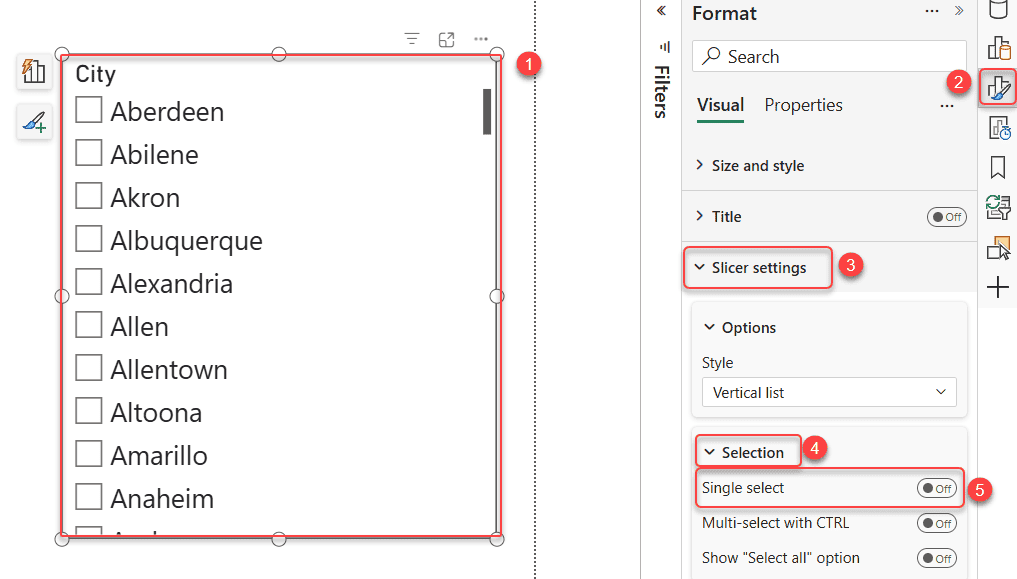
- Open your Power BI Desktop report and select the slicer visual on the canvas.
- Go to the Format pane (the paint roller icon in the Visualizations panel).
- Under the Visual tab, expand Slicer settings, then expand Selection.
- Toggle Single select to Off.
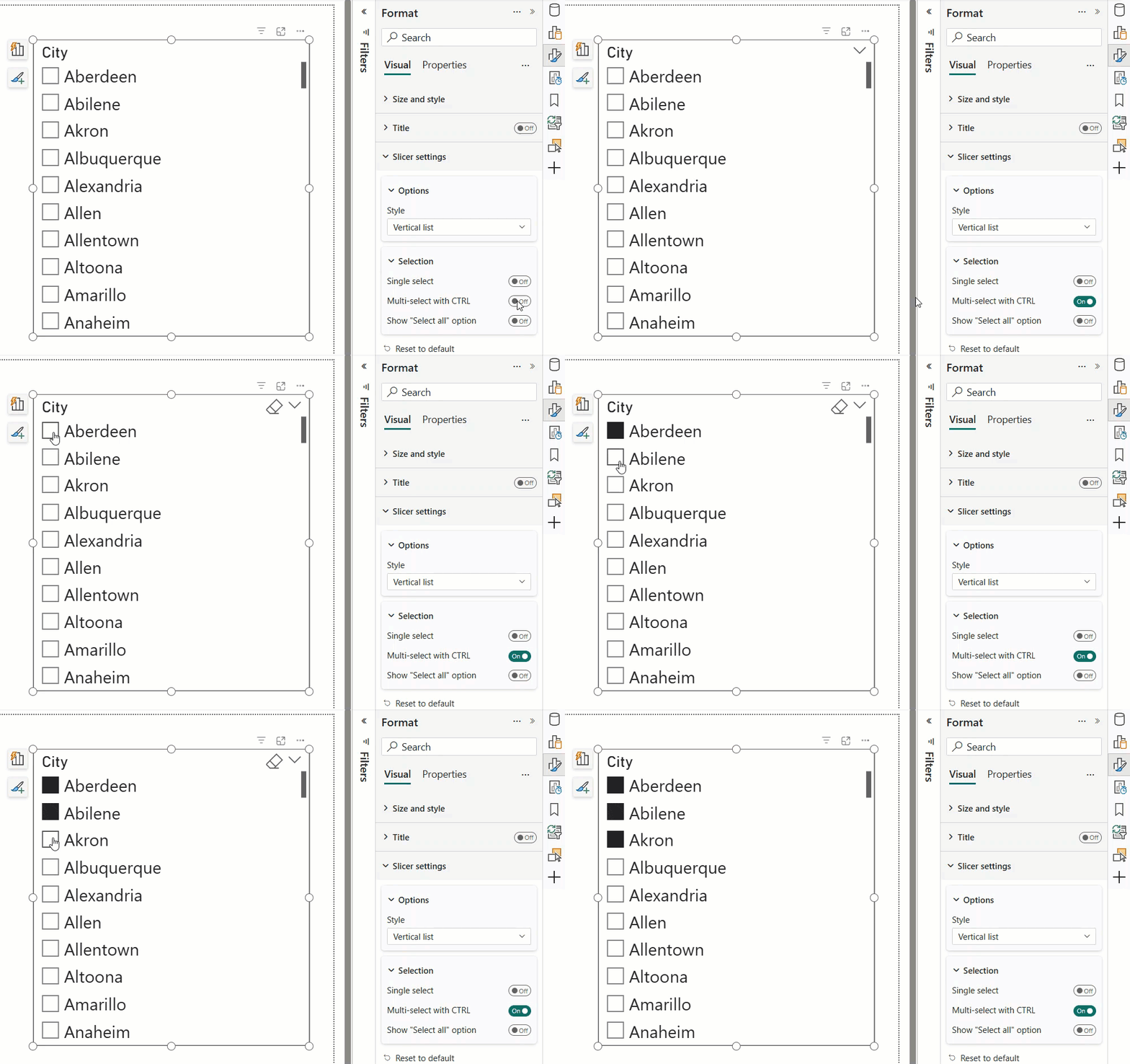
Once you turn off Single select, two new options appear:
- Multi-select with Ctrl — when this is ON, users need to hold Ctrl while clicking to add selections.
- If you turn Multi-select with Ctrl OFF, users can click values one by one without holding any key.
That second option is almost always what you want for a shared dashboard. Most users don’t know how to hold Ctrl, and they’ll assume the slicer is broken when it’s not.
Tip: Also turn on Select all from the same panel. This adds a “Select All” checkbox at the top of the slicer, which is very handy for letting users reset their selections quickly.
How to Select Multiple Values Without Holding Ctrl in a Power BI Slicer
This is the most common thing people want to do — just click values freely without any keyboard gymnastics.
Steps:
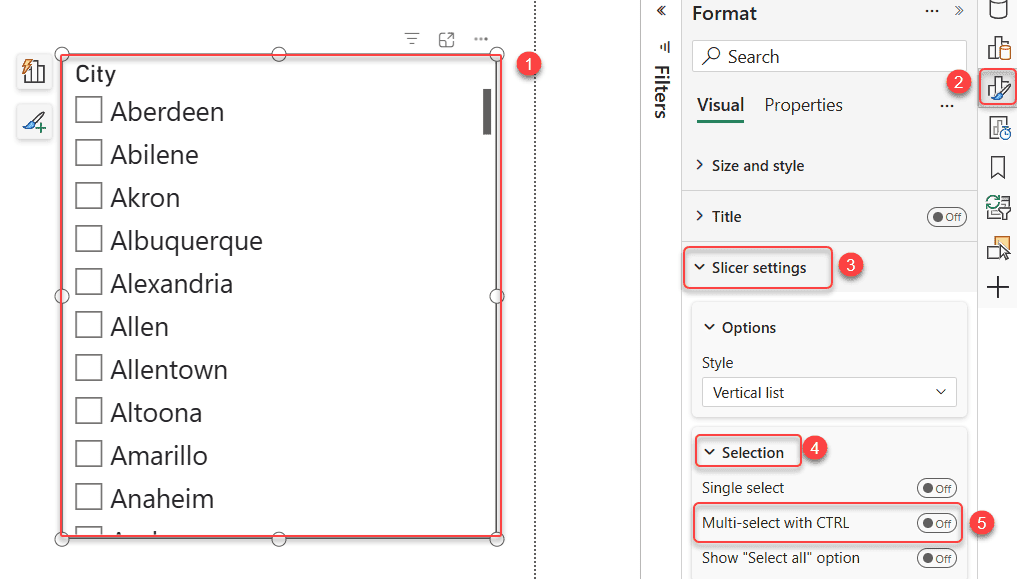
- Select your slicer on the report canvas.
- Open the Format pane → Visual tab → Slicer settings → Selection.
- Turn Single select to Off.
- Turn Multi-select with Ctrl to Off as well.
Now users can click any value, and it gets added to the selection. Click it again to deselect. It works exactly like checkboxes, which feels natural to most people.
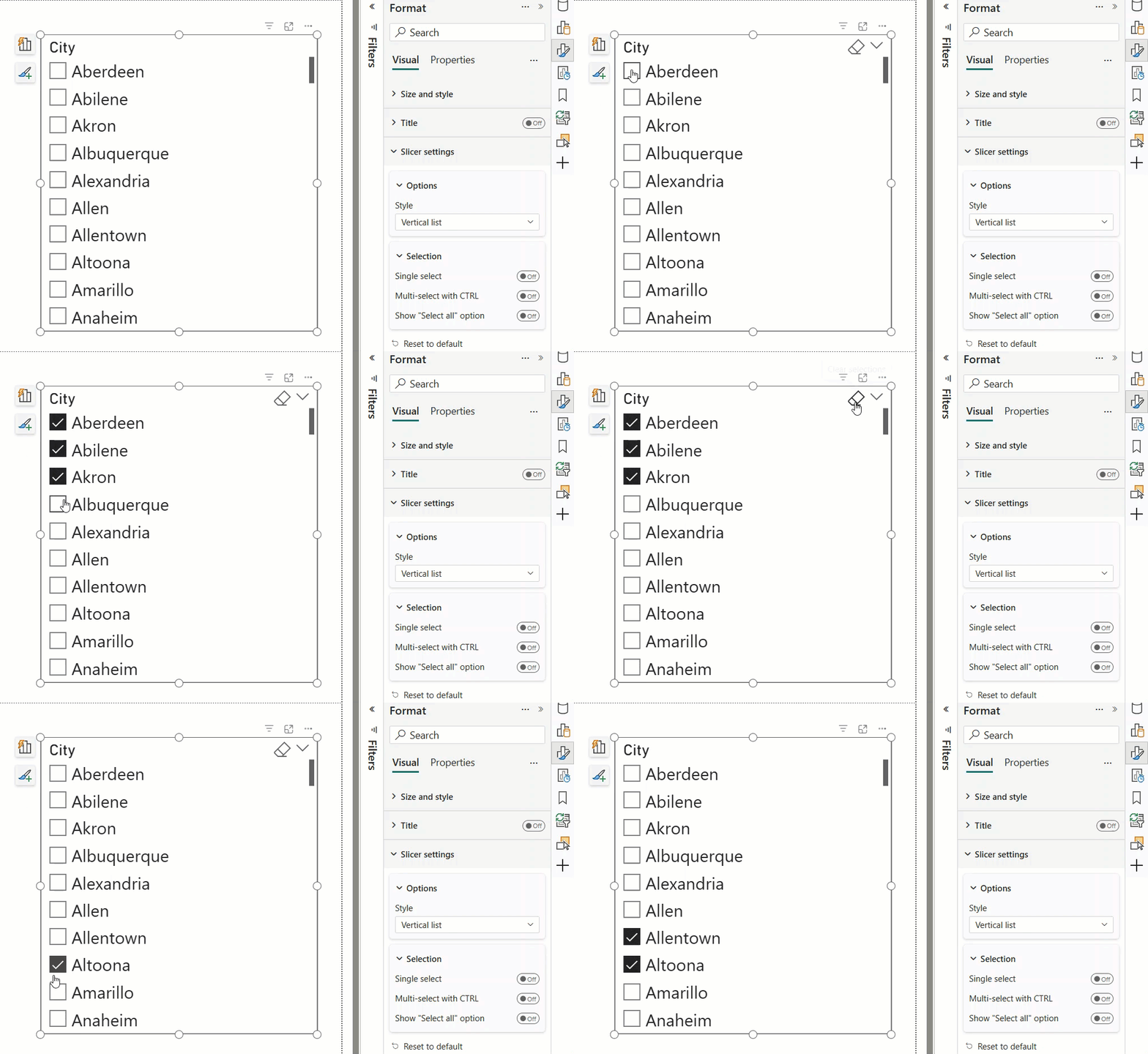
I always set slicers this way when building dashboards for non-technical users. It removes a hidden dependency they don’t know about, and it drastically reduces the “why is my filter not working?” questions.
How to Use a Power BI Slicer to Switch Between Multiple Measures
This one’s a bit different. Instead of filtering rows of data, we’re using the slicer to let users dynamically switch between different metrics on a chart — like toggling between Sales, Profit, and Units Sold on the same visual.
For this example i am using Power BI Default data, which conternts below column:
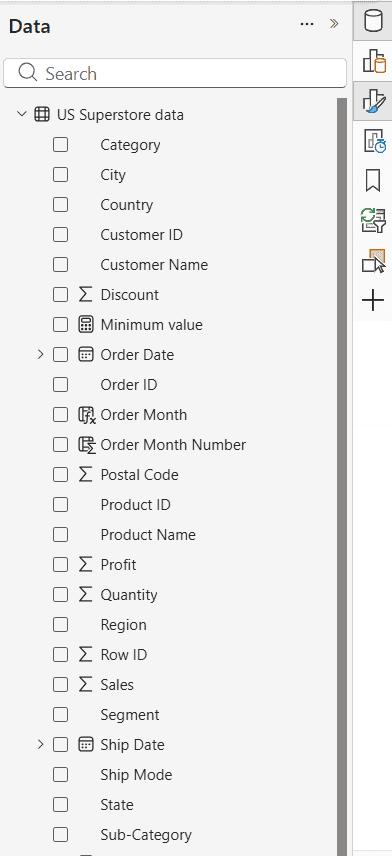
Here’s how I set this up:
Step 1: Create a helper table
Create a new table in Power BI with a single column listing your measure names:
- Go to Modeling -> New Table and create this table:
MeasureSelector =
DATATABLE(
    "Metric", STRING,
    {
        {"Sales"},
        {"Profit"},
        {"Quantity"}
    }
)
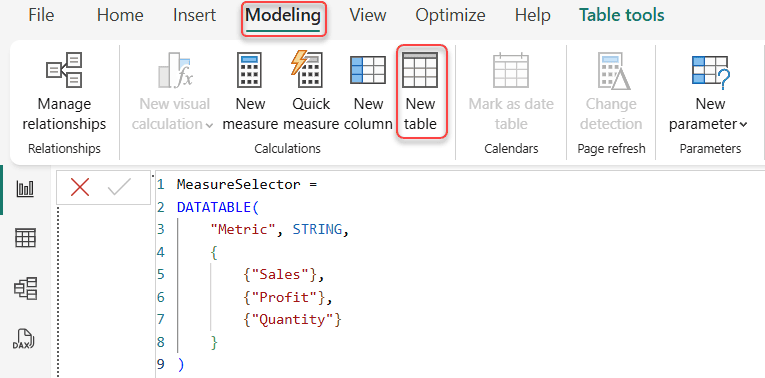
Or you can type it in manually using Enter Data (Home tab → Enter Data).
Step 2: Create conditional measures
For each metric, write a measure that only returns a value when the user has selected it in the slicer:
Show Sales =
IF(
    "Sales" IN VALUES(MeasureSelector[Metric]),
    SUM('US Superstore data'[Sales])
)

Show Profit =
IF(
    "Profit" IN VALUES(MeasureSelector[Metric]),
    SUM('US Superstore data'[Profit])
)

Show Quantity =
IF(
    "Quantity" IN VALUES(MeasureSelector[Metric]),
    SUM('US Superstore data'[Quantity])
)
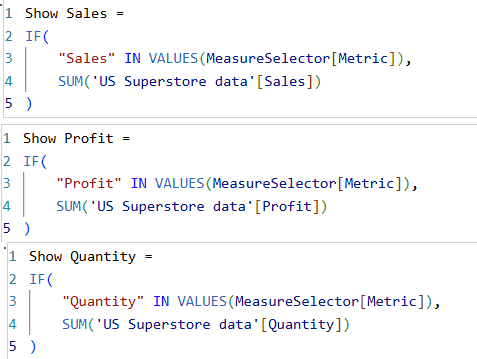
Step 3: Build the slicer and chart
- Add a slicer, drag the Metric column from your helper table into it.
- Go to Format → Slicer settings → Selection → turn off Single select → turn on Multi-select with Ctrl.
- Add a chart visual and use all three measures as your Y-axis values.
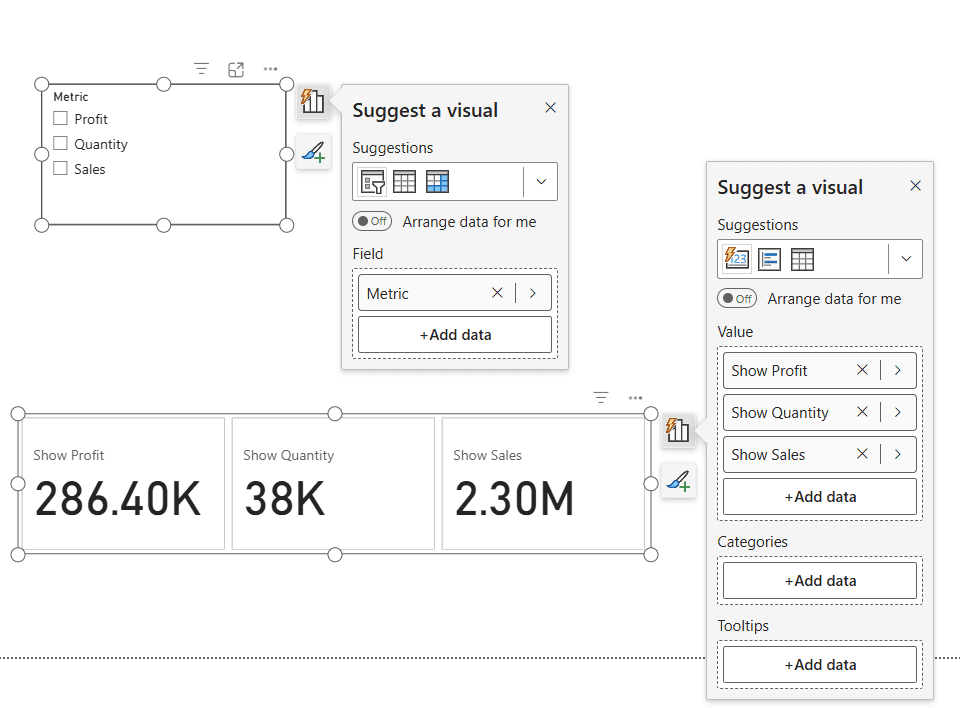
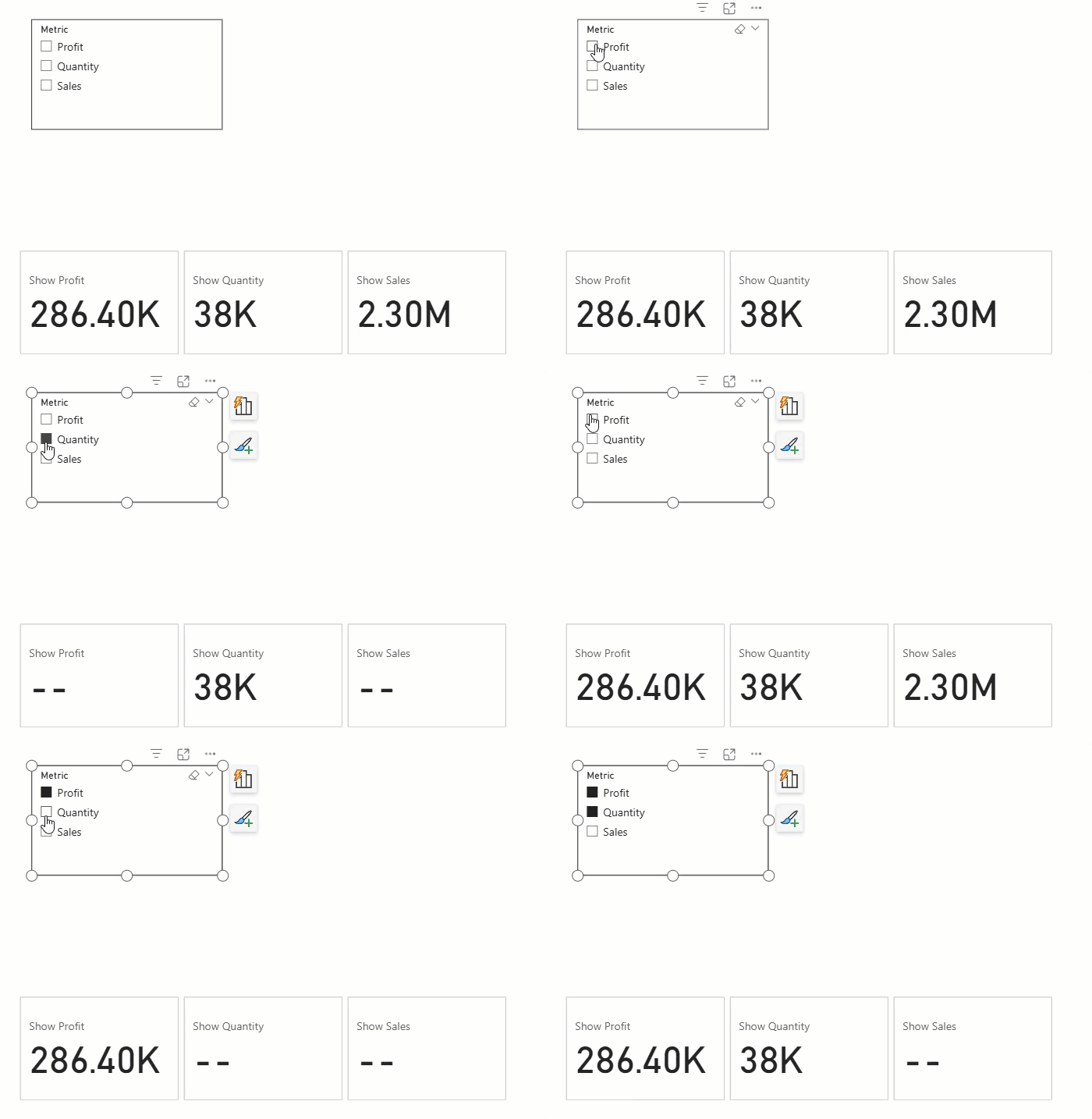
Now, when a user selects “Sales” and “Index” in the slicer, both values appear on the card. Deselect one, and it disappears. It’s a clean way to let users build their own view without cluttering the report with too many visuals.
Power BI Slicer Multi-Select Not Working — Here’s the Fix
If your slicer still only lets you pick one value even after following the steps above, go through this checklist:
- Is Single Select still ON? Go to Format → Slicer settings → Selection → confirm Single select is toggled Off.
- Are you on a published report in the browser? Report-level settings can sometimes prevent format changes. Make sure you’re editing in Desktop, not just viewing in the Power BI Service.
- Is the slicer a custom visual (like a marketplace one)? Third-party visuals override native settings. If you’re using a marketplace slicer, check that Visual’s own settings panel.
- Did someone enable Row-Level Security (RLS)? RLS can sometimes restrict slicer behavior depending on how filters are configured.
- Is your slicer a Date slicer set to “Between” mode? Date range slicers work differently — they use a date range picker, not checkboxes. If you need multi-select dates, switch to a list-type date slicer.
The most common culprit by far is just that Single Select is still turned on. It’s easy to miss because the toggle is nested under Slicer settings → Selection, not at the top level of the format pane.
Disable Multiple Selections in Power BI Slicer (Force Single Select)
Sometimes you specifically want users to pick only one value. For example, if your report logic breaks with multiple region selections, or your card visuals show percentages that don’t add up correctly with multi-select.
Steps:
- Select your slicer.
- Open Format pane → Visual tab → Slicer settings → Selection.
- Toggle Single select to On.
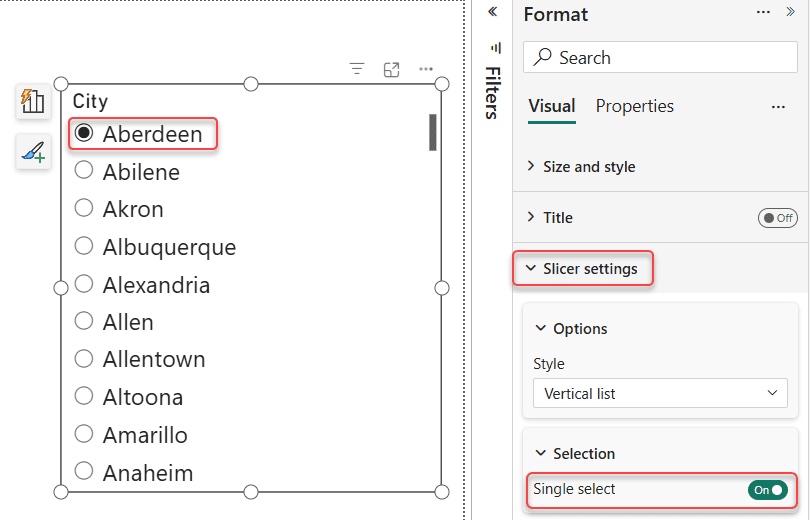
That’s it. Multi-select with Ctrl will be greyed out automatically. Users can only pick one value at a time, and clicking a new value deselects the previous one.
Horizontal Nav-Bar Style Slicer with Multi-Select in Power BI
If you want a sleek, pill-button style slicer laid out horizontally across your report — like a navigation bar — here’s how to do it with the built-in slicer visual.
Steps:
- Add a slicer visual and drag in your field (e.g., City, Product Category).
- Open the Format pane → Visual tab → Slicer settings → Options.
- Under Style, change the dropdown from List to Tile.
The slicer now shows as horizontally arranged tiles. From here:

- Enable multi-select by going to Selection → turn Single select Off.
- Style the tiles under the Values card — adjust font, colors, padding, and border radius to match your report theme.
This layout works really well for year selectors, region tabs, or any scenario where you have a small number of values and want them always visible without taking up vertical space.
Tip: If you want users to be able to select multiple tiles without holding Ctrl, also turn off Multi-select with Ctrl under the Selection card.
Paste Multiple Values into a Power BI Slicer (2025 Feature — Game Changer)
This is the feature I wish had existed five years ago. As of mid-2025, you can now paste a list of values directly into a Power BI slicer — no more clicking through hundreds of items one by one.
How it works:
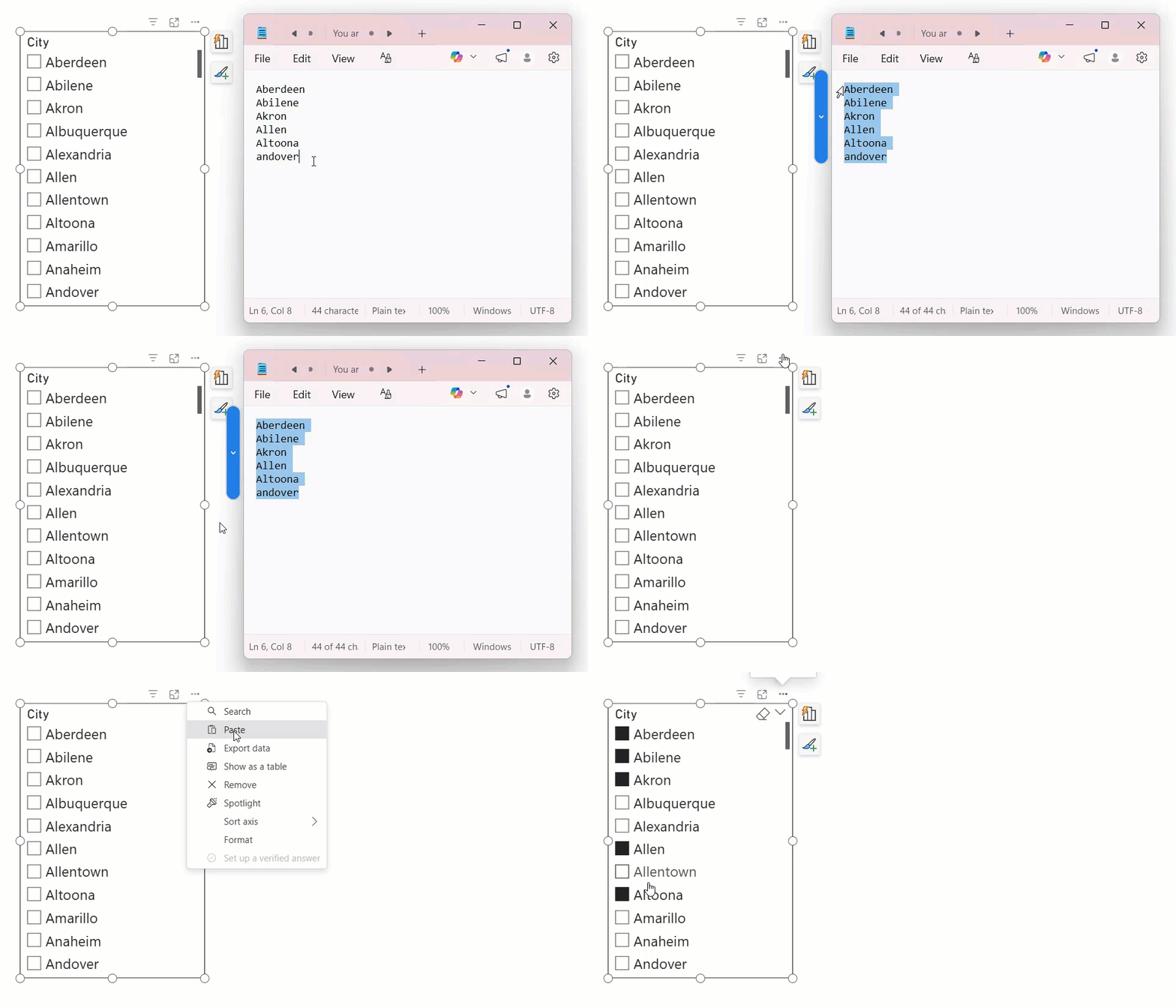
- Copy a list of values from Excel, Notepad, or an email. Each value must be on its own line (no commas, no headers — just one value per row).
- Select your slicer on the report canvas.
- Click the three-dot menu (…) in the top-right corner of the slicer.
- Click Paste from the context menu (or press Ctrl + V directly on the slicer).
- Power BI automatically matches and selects all values that exist in your dataset.
Important rules to know:
- You can paste up to 2,000 values — anything beyond that is silently ignored.
- Pasting replaces all existing selections, it doesn’t add to them.
- Matching is exact — if you paste “New York” but your dataset has “new york” (lowercase), it won’t match.
- If a pasted value doesn’t exist in the dataset, it still acts as a filter — so your visual might show blank. Double-check your source list for typos.
When this is incredibly useful:
Imagine a client emails you a list of 150 customer IDs they want to analyze. Previously, you’d manually hunt through the slicer or build a complicated filter. Now you just copy the list, paste it in, and you’re done in three seconds.
Note: To use this feature, you may need to enable the new list slicer in File → Options and Settings → Options → Preview Features → New list and button slicers. Restart Power BI after enabling it.
New List Slicer Features in Power BI You Should Know (2025–2026)
Power BI has been quietly upgrading slicers significantly. Here’s a roundup of what’s new:
Restrict to Leaf Nodes (Hierarchy Slicers)
If you have a hierarchy in your slicer (e.g., Year → Quarter → Month, or Chain → Store Manager), you can now restrict selection to only the lowest level.
- Go to Format pane → Slicer settings → Selection → toggle Restrict to leaf nodes to On.
- Now clicking a parent node (like “Year” or “Chain”) only expands/collapses it — it can’t be selected.
- Only the most granular level (Month, Store Manager) can be selected.
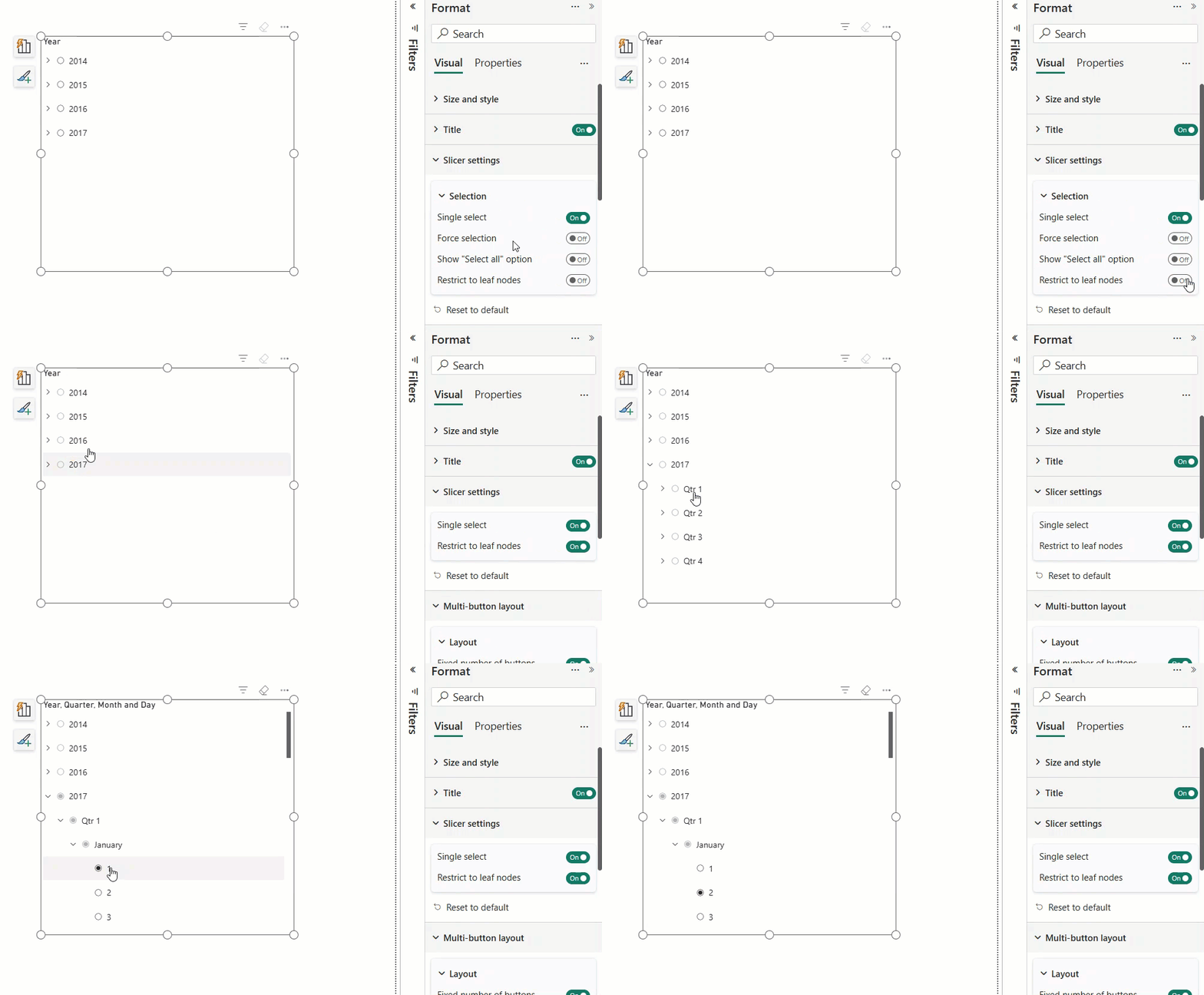
This prevents users from accidentally filtering by “Q1 2025” and getting all months within Q1 when they actually wanted to pick specific months.
Per-State Formatting
You can now format slicer items differently depending on their state:
- Default (unselected)
- Hover
- Selected
- Press
- Mixed (partially selected in a hierarchy)
And in hierarchy slicers, you can format each hierarchy level separately. So your top-level category can be bold and larger, while leaf-node items are regular weight.
Labels (Secondary Row Text)
You can add a secondary label row below each slicer value — useful for showing a subtitle, a metric value, or additional context alongside each option.
Images in Slicer Items
You can now embed images in slicer items by pointing to a URL column in your dataset. Great for product slicers, where showing a thumbnail makes the filter much more intuitive.
Common Mistakes to Avoid
- Forgetting to turn off Single Select before trying to enable multi-select — they conflict with each other
- Leaving Multi-select with Ctrl ON on a dashboard designed for non-technical users — they won’t know to hold Ctrl
- Pasting values with a header row included — the header will be treated as a data value and may not match anything
- Pasting comma-separated values in one line — the paste feature needs one value per line to work correctly
- Using a marketplace/custom slicer visual and then expecting native settings to control it — check that visual’s own format panel
- Not testing the slicer in the Power BI Service after publishing — behavior can sometimes differ from Desktop
You may also like:
- Power BI Slicer Dropdown
- Add Column Using Power BI Power Query Editor
- Select Multiple Values in Power BI Slicer
- Remove Leading Zeros in Power BI
- Change Data Type in Power BI
Frequently Asked Questions
Why is my Power BI slicer only allowing one selection?
The Single Select option is turned on. Go to Format pane → Visual → Slicer settings → Selection → toggle Single select to Off.
How do I select all values in a Power BI slicer at once?
Go to Format pane → Slicer settings → Selection → turn on Select all. This adds a “Select All” checkbox at the top of your slicer.
Can I sync multi-select slicers across report pages?
Yes. Go to View → Sync Slicers, then check which pages the slicer should apply to and whether it should sync or just be visible.
How do I show the selected slicer values in a card or text box?
Create a measure like this:Selected Values =
CONCATENATEX(
VALUES('YourTable'[YourColumn]),
'YourTable'[YourColumn],
", "
)
Then display that measure in a card or text box. It’ll dynamically list whatever is currently selected.
What’s the maximum number of values I can paste into a slicer?
2,000 values. Anything above that limit is ignored silently, so if you have a very large list, you might want to verify your selections after pasting.
Can I prevent users from clearing all slicer selections?
Yes. Go to Format pane → Slicer settings → Selection → toggle Force selection to On. This means at least one value must always be selected, and users can’t clear the slicer completely.
My pasted values aren’t being selected — why?
The paste feature uses exact matching. Check for leading/trailing spaces, differences in capitalization, or values that simply don’t exist in your current dataset. Also confirm each value is on its own separate line in the source list.

Preeti Sahu is an expert in Power Apps and has over six years of experience working with SharePoint Online and the Power Platform. She is the co-author of Microsoft Power Platform: A Deep Dive book. As a Power Platform developer, she has worked on developing various tools using Power Apps and Power Automate. She also makes Microsoft 365 videos and shares them on YouTube.

