
If you’ve ever clicked the export button in Power BI and got a truncated file, a grayed-out option, or worse — nothing at all — you’re in good company. I’ve been working with Power BI across enterprise environments for over 15 years, and export issues are one of the most common frustrations I see, even among experienced users.
This guide walks you through every way to export data from Power BI — Desktop, Service, and dashboards — including what to do when you hit the row limit and how to troubleshoot when exports simply stop working.
What Does “Export Data” Actually Mean in Power BI?
When you export data from a Power BI visual, you’re not exporting the full dataset sitting behind your report. You’re exporting the data that was used to build that specific visual — either the aggregated version (what you see on screen) or the raw row-level data behind it.
There are two types of exports in Power BI:
- Summarized data — the aggregated numbers visible in the visual (e.g., total sales per region)
- Underlying data — the individual rows behind those aggregates (e.g., every sales transaction that fed into those totals)
Understanding this difference saves a lot of confusion. I’ll cover both in detail below.
Who Can Export Data from Power BI?
Before diving into the steps, it’s worth knowing that not everyone can export data. Here’s what’s required:
- You need Build permission on the underlying dataset
- Your organization’s Power BI admin must have export enabled in the Tenant Settings (Admin Portal → Export and sharing settings)
- The report designer must allow exports — they can restrict it at the report level
- A Pro or Premium license is required for most export features in Power BI Service
In my experience, when someone tells me the Export option is missing or greyed out, the most common culprit is a Tenant-level restriction — not their own permissions. Always check the Admin Portal first before spending time troubleshooting elsewhere.
Which Export Method Should You Use? (Quick Decision Guide)
Use this as your starting point before diving into the steps:
| Your Situation | Best Export Method |
|---|---|
| Need a quick snapshot of what’s on screen | Export Summarized Data → .xlsx or .csv |
| Need the raw rows behind a visual | Export Underlying Data → .xlsx (Service only) |
| Need to export a full table including DAX columns | Copy Table from Desktop → paste into Excel |
| Need more than 150,000 rows | Use Paginated Reports or DAX Studio |
| Need to schedule automated exports | Power Automate |
| Need a live, always-refreshed Excel connection | Analyze in Excel |
Summarized Data vs. Underlying Data — Which Should You Export?
This is the question I get asked most often, so let me explain it clearly with a real example.
Say you have a bar chart showing total sales by region — 5 bars, one per region.
- Summarized export gives you 5 rows: one per region, with the total sales figure. That’s exactly what you see on the chart.
- Underlying export gives you every individual sales transaction that contributed to those 5 region totals — could be thousands of rows.
Use summarized data when:
- You’re preparing a management report or presentation
- You want the aggregated numbers as displayed
- You’re sharing results, not raw data
Use underlying data when:
- You’re auditing figures and need to trace a number back to source transactions
- You’re doing further analysis in Excel or SQL
- You want to understand what’s driving a particular total
One thing to note: Underlying Data is only available in Power BI Service, not Desktop. And it removes aggregates entirely — you get the raw data, not the summed version.
How to Enable Export Data in Power BI
If the export option doesn’t appear for your users, here’s how to turn it on.
In Power BI Desktop (Report-Level Setting)
- Open Power BI Desktop
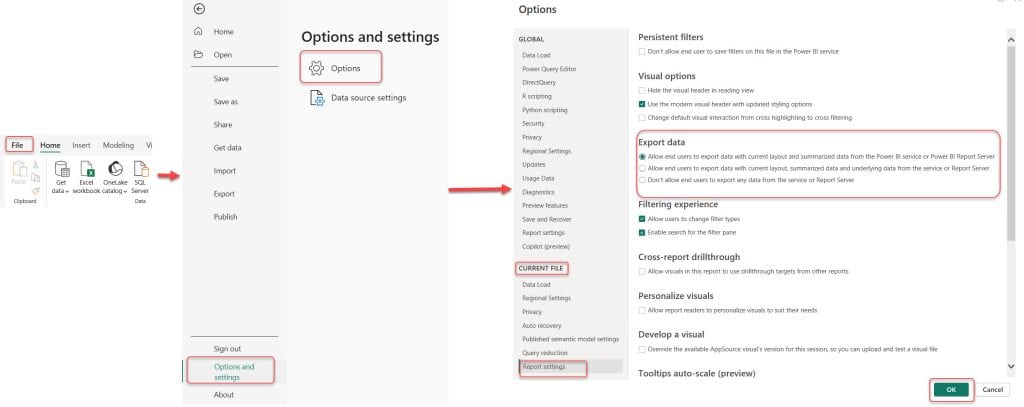
- Go to File → Options and Settings → Options
- Under Current File, click Report settings
- Under Export data, choose one of:
- Allow end-users to export summarized data only
- Allow end-users to export both summarized and underlying data
- Don’t allow export (disables it for consumers)
- Click OK
In Power BI Service (Admin-Level Setting)
- Go to the Power BI Admin Portal
- Click Tenant Settings
- Scroll to Export and sharing settings
- Ensure Export data is toggled On
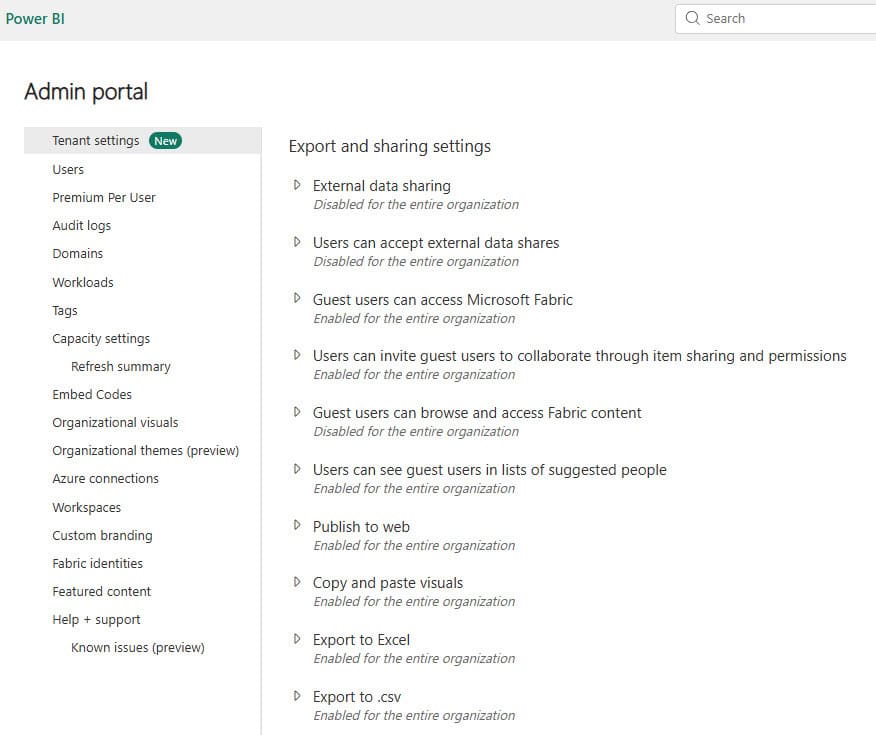
If you don’t have admin access and export is missing, raise it with your Power BI admin — this is a centralized setting that affects all users in your organization.
How to Export Data from Power BI Desktop
This is the most straightforward method. Here’s how to do it step by step:
- Open your report in Power BI Desktop
- Click on the visual you want to export (chart, table, matrix, etc.)
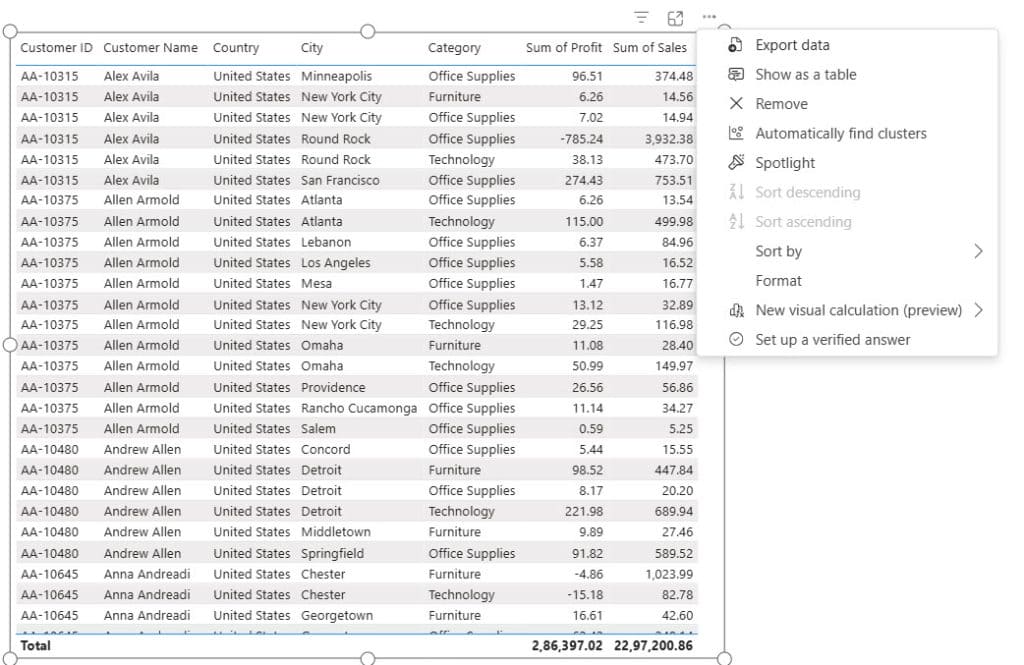
- Click the More options (…) icon that appears in the top-right corner of the visual
- Select Export data
- Choose your export format — in Desktop, this saves as a .csv file
- Pick a save location on your computer and click Save
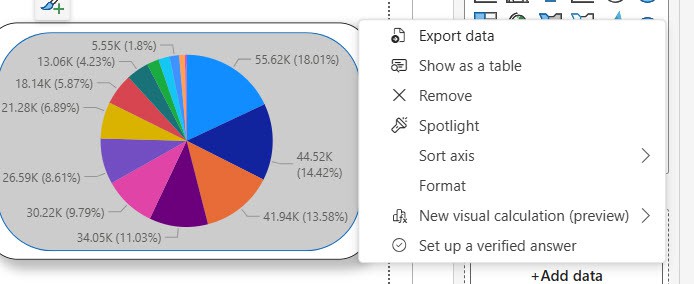
Open the file in Excel and you’ll see your exported data. Keep in mind: Desktop only exports Summarized data in CSV format — if you need underlying data or an .xlsx file, use Power BI Service instead.
How to Export Data from Power BI Service (Report)
Exporting from the Service gives you more format options, including .xlsx.
- Open the report in Power BI Service (app.powerbi.com)
- Click on the visual you want to export
- Click the More options (…) icon
- Select Export data
- In the Export dialog, choose:
- Summarized data or Underlying data
- File format: .xlsx or .csv
- Click Export
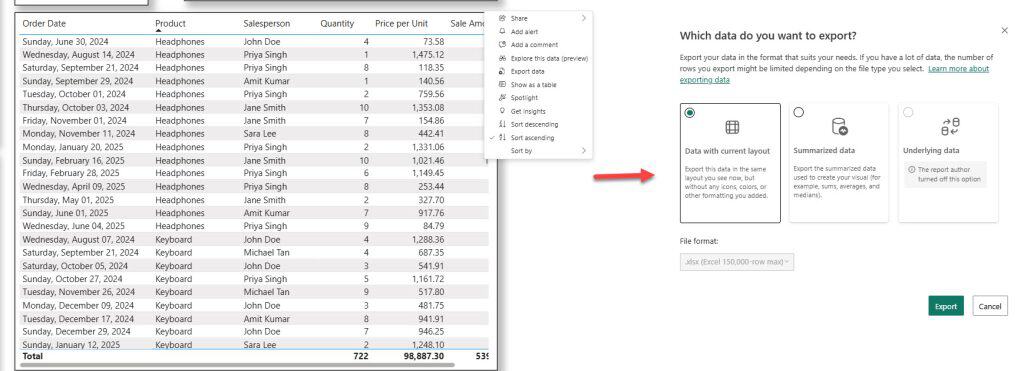
The file downloads to your browser’s default Downloads folder. Open it in Excel to access your data.
One practical tip here: if you’re exporting a table visual with many columns, try removing columns you don’t need before exporting. This reduces file size and avoids hitting the 16 MB uncompressed limit on DirectQuery reports.
How to Export Data from a Power BI Dashboard
Dashboards work slightly differently from reports — each tile on a dashboard is a pinned visual from a report.
- Open your dashboard in Power BI Service
- Hover over the tile you want to export
- Click the More options (…) icon on the tile
- Select Export data
- Choose Summarized data, select .xlsx, and click Export
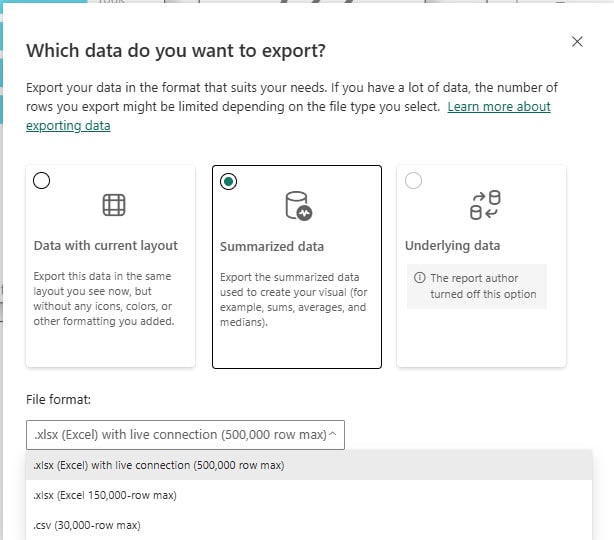
Note: Dashboard tiles only support Summarized data export. If you need Underlying data, go back to the original report that the tile was pinned from.
How to Export a Full Table from Power BI Desktop (Copy Table Method)
This is a lesser-known method that I find really useful when you need a full, clean table export including all DAX calculated columns.
- In Power BI Desktop, go to the Data view (the table icon on the left panel)
- Select the table you want to export from the Fields pane on the right
- Right-click on the table name
- Select Copy table
- Open an Excel workbook and paste (Ctrl+V)
- Save the file as .csv or .xlsx
When this method works well:
- You’ve done Power Query transformations and want the clean, post-transformation data
- You need all DAX calculated columns included
- The table isn’t too large (this method gets slow above ~100,000 rows)
When to avoid it:
- Large datasets — pasting can freeze both Power BI Desktop and Excel
- You need the data in a structured, repeatable workflow
Power BI Export Limits — Everything You Need to Know
This is the most important section if you’re dealing with incomplete exports or truncated files. Here’s a full breakdown of the limits as of 2026:
| Export Method | Mode | Max Rows | Max File Size | Format |
|---|---|---|---|---|
| Visual Export | Import Mode | 30,000 | — | .csv |
| Visual Export | Import Mode | 150,000 | — | .xlsx |
| Visual Export | DirectQuery / Live Connection | Up to 150,000 | 16 MB uncompressed | .xlsx / .csv |
| Underlying Data | Import Mode | 500,000 | — | .xlsx (Service only) |
| Paginated Reports | Any | No row cap | Memory-bound | .xlsx, .csv, .pdf, .docx |
| Copy Table (Desktop) | Import Mode | No hard limit | Performance-bound | Paste to Excel |
Additional limits to know:
- Underlying Data export does not work if the table in the data model has no unique key
- Underlying Data export breaks when “Show items with no data” is enabled on the visual
- If the report version is older than 2016, Underlying Data export is unavailable
- If your visual uses data from multiple unrelated tables with no active relationship, Power BI only exports the first table’s data
- R visuals and custom visuals don’t support data export
- If a column name alias was used in Power BI and you export to Excel, it reverts to the original field name
- Unicode characters in .csv files may not render properly in Excel — import the file via Data → Get External Data → From Text instead of double-clicking
How to Export More Than 150,000 Rows from Power BI
Hitting the 150K row limit is a real pain, especially when you need full dataset extracts for auditing or downstream processing. Here are your four realistic options:
Option 1: Paginated Reports (Best Method)
Paginated Reports are specifically designed for large, formatted data exports. There’s no row cap — the only limit is your capacity’s memory.
- Requires a Power BI Premium, Premium Per User (PPU), or Fabric capacity license
- Supports export to Excel, CSV, PDF, Word, and XML
- Use Power BI Report Builder to create paginated reports
- Can be embedded directly in Power BI Service
If your organization has PPU or Premium, this should be your default method for large exports.
Option 2: Underlying Data Export (Up to 500,000 Rows)
If you’re in Import Mode and need more than 150K rows from a visual, switch to Underlying Data export — this supports up to 500,000 rows.
Option 3: DAX Studio
DAX Studio is a free, community-built tool that connects to your Power BI model and lets you write DAX queries and export the results directly to CSV or Excel — with no row cap.
- Download from daxstudio.org
- Connect to your open Power BI Desktop file
- Write a simple
EVALUATEquery (e.g.,EVALUATE 'Sales') - Export results to CSV
This is my go-to for ad hoc large data extracts when the report doesn’t have a paginated version set up.
Option 4: Power Automate (For Scheduled/Automated Exports)
If you need exports to run automatically on a schedule (e.g., daily export of a dataset to SharePoint or email), Power Automate is the right tool. You can create a flow that:
- Triggers on a schedule
- Calls the Power BI export API
- Saves the file to SharePoint, OneDrive, or sends it via email
This is ideal for operational reporting where the same data needs to be extracted and distributed regularly.
Export Not Working? Troubleshooting Checklist
Before you spend an hour digging through settings, run through this checklist:
- Is the Export Data option enabled in File → Options → Report Settings (Desktop)?
- Has the Power BI Tenant admin disabled export in the Admin Portal?
- Do you have Build permission on the underlying dataset?
- Is the report version 2016 or newer? (Older versions block Underlying Data)
- Does your table have a unique key column in the data model? (Required for Underlying Data)
- Is “Show items with no data” enabled on the visual? (Turn it off to restore Underlying Data export)
- Are you using a Matrix visual? Try switching to a Table visual and exporting from there
- Are you on DirectQuery and getting a partial file? You may be hitting the 16 MB size cap — reduce columns
- Is the visual a custom visual or R visual? These don’t support export — re-create as a native visual
- Did the export “succeed” but no file appeared? Check your browser’s Downloads folder and pop-up blocker settings
- Is the data appearing blank in Excel? If the CSV has Unicode characters, import it via Data → From Text instead of double-clicking
If all of these check out and export still fails, try duplicating the visual, publishing a fresh copy of the report, or exporting from a newly created report connected to the same dataset.
Analyze in Excel — A Better Alternative for Live Data
One thing worth knowing: if you export data and the report refreshes the next day, your exported file is immediately out of date. That’s a real problem if you’re building dashboards or tracking live metrics.
Analyze in Excel solves this. Instead of a static export, it creates a live PivotTable connected directly to your Power BI dataset — so it refreshes every time you open it.
To use it:
- In Power BI Service, open the dataset
- Click More options (…) → Analyze in Excel
- Download and open the .odc file
- Build your PivotTable using live Power BI data
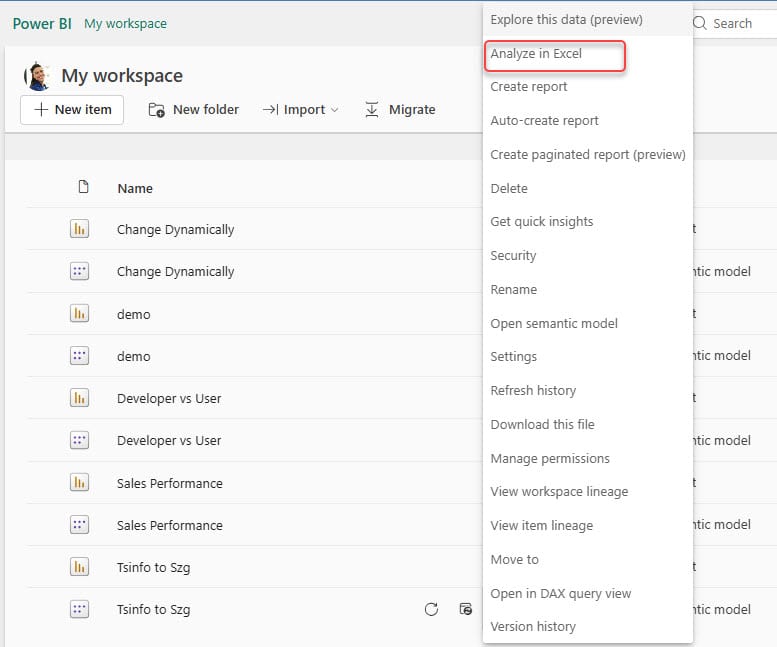
This is available with a Pro license and works in Excel 2016 or later. I’d strongly recommend this approach for anyone doing ongoing analysis rather than a one-time extract.
You may also like the following tutorials:
- Create a Power BI Slicer Panel
- Power BI Slicer Default Value
- Create Ribbon Chart in Power BI
- Power BI Desktop (Step‑by‑Step Guide for Beginners)
- Power BI Row Level Security Tutorial (RLS) for Beginners
FAQs
Why is the Export Data button grayed out or missing?
Usually, this is because the Tenant admin has disabled export organization-wide, or the report designer has turned it off at the report level. Check File → Options → Report Settings (Desktop) or the Admin Portal Tenant Settings (Service).
Can I export more than 150,000 rows from Power BI?
Yes. Use Underlying Data export (up to 500,000 rows in Import Mode), Paginated Reports (no row limit, requires Premium/PPU), or DAX Studio for ad hoc extracts.
What’s the difference between Summarized and Underlying Data?
Summarized gives you the aggregated data you see in the visual. Underlying gives you the raw, row-level data behind it — with aggregates removed.
Does exporting data require a Power BI Pro license?
For exporting from Power BI Service, yes — a Pro or Premium Per User license is required. Desktop exports to CSV are available without a license.
Can I export Power BI data to Google Sheets?
Not directly from the export menu. The most reliable route is to export to CSV first, then import into Google Sheets, or use Power Automate to push data into Google Sheets via a connector.
Why does my exported CSV look garbled in Excel?
This usually happens with Unicode characters. Don’t double-click the file — instead, open Excel, go to Data → Get External Data → From Text, and import the CSV using the Text Import Wizard with UTF-8 encoding.
What happens to column names when I export to Excel?
If you renamed a field using an alias in Power BI, the export reverts to the original field name from the data model. This is a known limitation — rename columns in your data model if consistent naming matters.

After working for more than 18 years in Microsoft technologies like SharePoint, Microsoft 365, and Power Platform (Power Apps, Power Automate, and Power BI), I thought will share my SharePoint expertise knowledge with the world. Our audiences are from the United States, Canada, the United Kingdom, Australia, New Zealand, etc. For my expertise knowledge and SharePoint tutorials, Microsoft has been awarded a Microsoft SharePoint MVP (12 times). I have also worked in companies like HP, TCS, KPIT, etc.

