
In this Power BI tutorial, I will explore how to work with Power BI combine two tables with same columns, how to combine two columns from different tables in Power BI DAX, and Power BI combine columns from different tables, including some more topics below:
- How to merge columns from different tables in Power BI
- Power query combines tables with different columns
- Power query combine two tables with same columns
- Power BI concatenate two columns from different tables
- Power query concatenate two columns
- Power BI compare two columns in different tables
- Power BI add two columns from different tables
Power BI Combine Two Tables With Same Columns
Here, we will see how to combine two tables with the same column using DAX.
For example, we have two tables i.e., Emp1 and Emp2, which contain the same columns: Id, Name, and Age.
Now, we will combine both tables and create a new table using Power BI Union ().
Emp 1

Emp 2

Union(): This function is used to combine tables having the same structure into a single table. After performing the union of tables with the same columns, you can see the result below.

To combine two tables with the same columns using Power BI, follow the below steps:
- Open Power BI Desktop and load the data using the Get Data option.
- Now we will create a new table so click on the Modelling and click on New table.
- Then, provide the Dax formula in the Formula box:
Emp 1 + Emp 2 = UNION(Emp1,Emp2)
- Now you can see both the tables combined having the same column using Power BI DAX Union().
This is an example of combine two tables with the same columns in Power BI.
Combine two columns from different tables in Power BI Dax
Here, we will see how to combine two columns from different tables using Power BI Dax.
In this example, we have two tables, Emp 1 and Emp 2, as you can see below. We will combine the two columns, Name, and Age, using the Union function.
Emp1

Emp2

After combining two columns from different tables using Power BI Dax, the result will look like the one below.

To perform this in Power BI, follow the below steps:
- In Power BI Desktop, load the data using the Get Data option.
- To create a new table, click on the Modelling tab -> select the ‘New table’ option.
- Then, write the below formula in the formula box.
Combine2Columns = UNION(SUMMARIZE(Emp1,Emp1[Name],Emp1[Age]),SUMMARIZE(Emp2,Emp2[Name],Emp2[Age]))
Now you can see the two columns are combined from different tables using Power BI Dax.
This is an example of combine two columns from different tables in Power BI.
Power query combine tables with different columns
Here, we will see how to combine tables with different columns using Power Query
We will use the Emp 1 and Emp 2 table below, and using Append queries, we will combine the table with different columns using Power Query in Power BI.
Emp 1

Emp 2

After combining the tables with different columns using Power Query, it will look like the below. If there is no match column, it will create a separate column.

To do this in Power Query, follow the below steps:
- In Power BI, Load the above data using the Get Data option.
- Then click on the Transform data option from the ribbon.

- In Power Query Editor, click on the Append Queries -> select Append queries as new.

- In the Append Queries window, select the ‘Two tables’ option, then select the table you want to combine. Then, click on OK.

Now you can see tables are combined with different columns using Power Query.
This is an example of combining tables with different columns using Power Query.
Power query combine tables with the same columns
Here, we will see how to combine tables with the same column using Power Query in Power BI.
In this example, we will take the Emp1 and Emp 2 tables, which have the same column, and see how to combine them using Power Query in Power BI.
Emp 1

Emp 2

Result: combining two tables with the same columns using Power Query.

To do this using Power Query, follow the below steps
- In Power BI, load the above data using the Get Data option.
- Then click on the Transform data option from the ribbon.
- To combine the tables with the same column, in Power Query Editor, click on Append Queries -> select Append queries as new.
The Append Queries window will open. Select the ‘Two tables’ option, then select the table you want to combine. Then, click on OK.
Now you can see the tables are combined with the same columns using Power query.
This is an example of combine tables with the same columns using Power query.
Power BI concatenate two columns from different tables
Here, we will see how to concatenate two columns from different tables using Power BI
For example, we have 2 tables, Employee 1 [ID, Name] and Employee 2[ID, Department]; here, we will see how to concatenate the Name and Department columns.
Employee 1

Employee 2

Result: concatenate columns from different tables in Power BI

Follow the below steps to concatenate columns in Power BI.
- Open Power BI Desktop and load the data using the get data option.
- Once you load the data, go to the Model view, and create a one to one relationship between the table like below.
- You can create a relationship by dragging the ID column from Employee 1 to Employee 2

- In the Employee 1 table, create a new column. For this, click on the Modeling table and click on the New column.
- Then, write the formula below in the formula box.
Name-Department = CONCATENATE('Employee 1'[Name] & "-" , RELATED('Employee 2'[Department]))
Now you can see two columns are concatenated from different tables in Power BI
This is an example of concatenating two columns from different tables using Power BI.
Power query concatenate two columns
Here, we will see how to concatenate two columns using Power Query.
For example, we have the below table, Employee, which contains 3 columns: ID, First Name, and Last Name. We will concatenate the First and Last name columns to create a Full name column using Power Query in Power BI.

Result

Follow the below steps to concatenate two columns using Power Query
- In Power BI Desktop, load the data using the get data option.
- Click the Transform data option in the ribbon to open the Power Query editor.
- To concatenate two columns, select (Ctrl +click) the columns from the table.
- Then, go to the Add Column tab and select the Merge Column option.
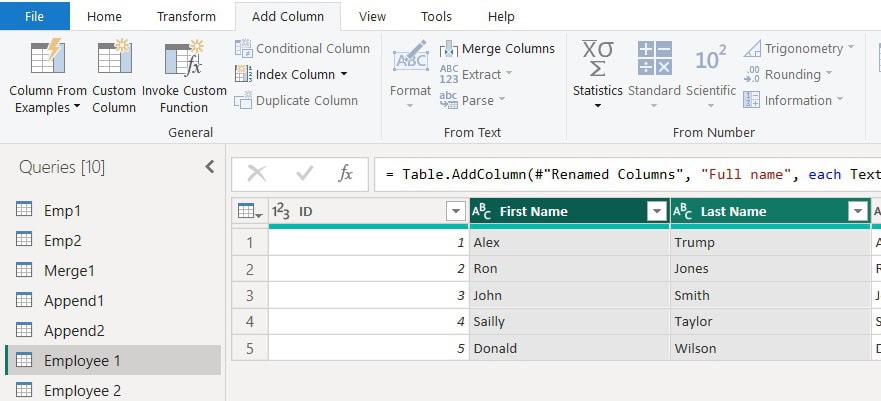
- The merge column window will now open. Select the Separator and provide the New column Name as the Full name. Then click on OK.

Now you can see the two columns are concatenated using Power query.

This is an example of concatenating two columns using a Power query.
Power BI compare two columns in different tables
Here, we will see how to compare two columns in different tables using Power BI.
For example, we have two tables: Sales[ Month, Sales Amount] and Budget[Month, Budget Amount]. Using Power BI Dax, we will compare the Sales amount with the budget amount in different tables.
Sales

Budget

Result

To perform this in Power BI, follow the below steps
- In Power BI Desktop, load the data using the get data option.
- Then click on the Modeling tab and select the New column from the ribbon.
- Then, in the formula box, write the below formula:
Sales vs Budget = RELATED(Sales[Sales Amount]) - Budget[Budget Amount]
Now you can compare two columns in different tables in Power BI.
This is an example of comparing two columns in different tables in Power BI.
Power BI adds two columns from different tables
Here, we will see how to add two columns from different tables using Power BI
For example, we have two tables: Sales [Month, Sales Amount] and Expenses [Month, Expense Amount]. Using Power BI Dax, we will add the Sales amount to the expense amount to get the Total revenue.
Sales

Expense

Result

To perform this in Power BI, follow the below steps
- In Power BI Desktop, load the data using the get data option.
- Then click the Modeling tab and select the New column from the ribbon.
- Then, in the formula box, write the below formula:
Total Revenue = RELATED(Sales[Sales Amount]) + Expense[Expense Amount]
Now you can see the two columns get added from different tables in Power BI.
This is an example of adding two columns from different tables in Power BI.
Additionally, you may like:
- Power BI Clustered Bar Chart
- Donut Chart in Power BI
- Power BI Scheduled Refresh
- Create Stacked Funnel Chart in Power BI
- How to Set as Total in Power BI Waterfall Chart
- How to Apply Conditional Formatting in Power BI Area Chart
Conclusion
In this Power BI tutorial, we saw how to combine two tables with same columns using Power BI Dax.
Moreover, we covered the topics below:
- Combine two columns from different tables in Power BI Dax
- Power query combines tables with different columns
- power query combine tables with same columns
- Power BI concatenate two columns from different tables
- Power query concatenate two columns
- Power BI compare two columns in different tables
- Power BI add two columns from different tables

After working for more than 18 years in Microsoft technologies like SharePoint, Microsoft 365, and Power Platform (Power Apps, Power Automate, and Power BI), I thought will share my SharePoint expertise knowledge with the world. Our audiences are from the United States, Canada, the United Kingdom, Australia, New Zealand, etc. For my expertise knowledge and SharePoint tutorials, Microsoft has been awarded a Microsoft SharePoint MVP (12 times). I have also worked in companies like HP, TCS, KPIT, etc.


Great content! Keep up the good work!
Open power bi desktopLoad the data using Get data.Go to Data view, click on New tableThe information above gives you much easy access for data. Power BI helps to get easy visualization for you.
Power BI is a collection of software services, apps, and connectors that work together to turn your unrelated sources of data into coherent, visually immersive, and interactive insights.