
A client once built a flow that read his Outlook calendar with Get calendar view of events (V3) and wrote the events to an Excel file. It worked every time he ran it. Then he shared the flow with a colleague, and her runs failed with “The specified object was not found in the store”.
The message is vague, but it always means the same thing: the Office 365 Outlook connector couldn’t find a mailbox, folder, calendar or message for the account it’s running as. In this tutorial, I’ll show you how to work out which one is missing and how to fix it.

Quick answer: The connection used by the Outlook action can’t see the mailbox, calendar or message it’s pointing to. If the flow is shared, make sure the owner’s connection is used, because every user’s calendar has a different ID. For shared mailboxes, fill in Original Mailbox Address and check permissions. If a message was moved or deleted, get its ID again. If nothing else works, delete the Outlook connection and create a new one.
Where you’ll see this error
It shows up on Office 365 Outlook actions that point to a specific mailbox item or folder, such as:
- Calendar actions: Get calendar view of events (V3), Get events (V4), Create event (V4), and the event triggers.
- Email actions: Get email (V2), Move email (V2), Flag email (V2) and Mark as read or unread (V3).
- Shared mailbox actions and triggers, such as When a new email arrives in a shared mailbox (V2).
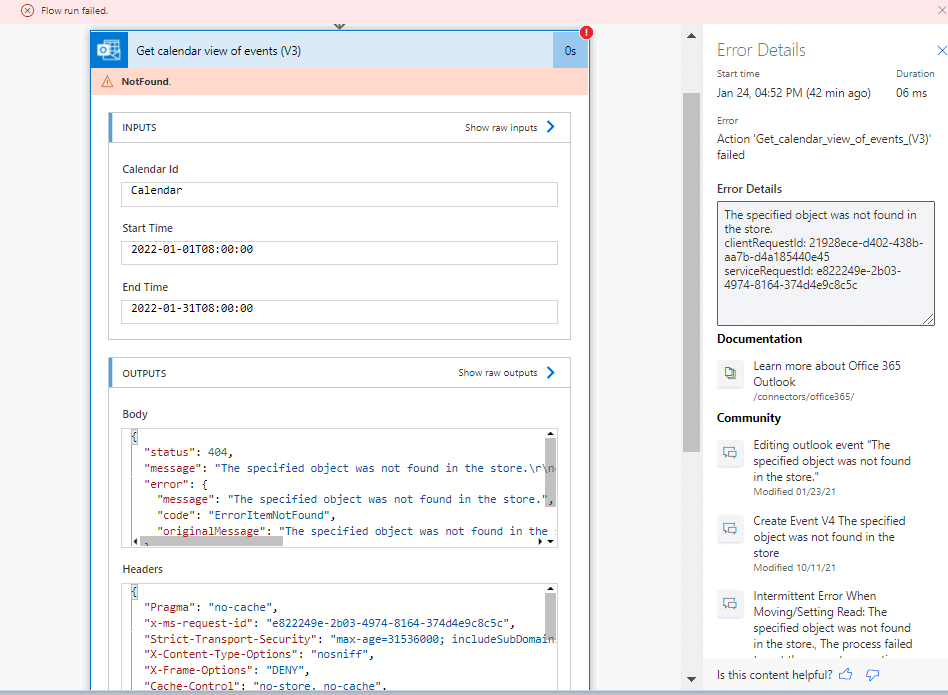
In the run history, the failed action shows the message, often with a 404 “ErrorItemNotFound” status for calendar actions:
If you’re building a calendar flow from scratch, see how to create Outlook calendar events with Power Automate.
Use this table to jump to the right fix:
| What’s happening | Likely cause | Fix |
|---|---|---|
| Works for the owner, fails for someone the flow is shared with | The calendar ID belongs to the owner | Fix 1 |
| Fails on a shared mailbox or room calendar | Missing permission or Original Mailbox Address | Fix 2 |
| Fails on Get, Move or Flag email | The message was moved or deleted | Fix 3 |
| Fails after a calendar was renamed or deleted | The stored folder ID no longer exists | Fix 4 |
| Fails for everyone, suddenly | A broken connection | Fix 5 |
Fix 1: The calendar belongs to someone else
This was my client’s problem, and it’s the most common one. When you pick a calendar in an Outlook action, Power Automate stores that calendar’s ID, not its name. Every user has a unique ID for their own calendar, even when both are simply called Calendar.
My client’s flow was very close to the one I use to export Outlook calendar events to Excel, so you can rebuild it from there if you need to.
So when the shared flow runs with the colleague’s connection, it asks her mailbox for the owner’s calendar ID. Her mailbox doesn’t have it, and the action fails. You can see this yourself by running Get calendars (V2) once with each account and comparing the IDs.
Option A: Use the owner’s connection
Microsoft’s documented fix is to make sure the owner’s connection is used for the Outlook action. If the colleague is a co-owner, open the flow, select the Outlook action and check that it uses the owner’s connection.
For a manually triggered flow, you can also share it as a run-only user and choose the owner’s connection for Office 365 Outlook instead of “Provided by run-only user”. The colleague can then run it, and it reads the owner’s calendar every time.
I explain the sharing options step by step in Power Automate run-only users.
Option B: Give each user their own copy
If each person should read their own calendar, have them make a copy. They open the flow from their shared flows list:
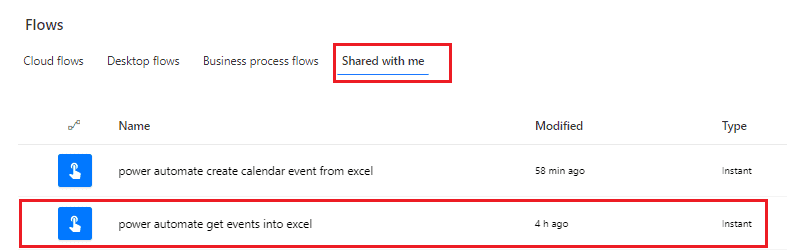
Then they open the … menu and select Save As:

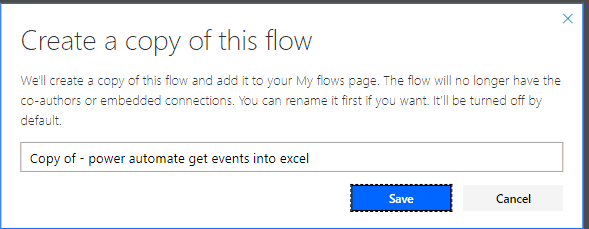
They give the copy a name and save it. The copy is now their own flow:
Here’s the important part that’s easy to miss: open the copy, check that every Outlook action uses their own connection, and select the calendar again in the Calendar Id field. Otherwise, the copy still holds the owner’s calendar ID.

Fix 2: Shared mailbox and room calendar actions
When the action reads a shared mailbox, such as support@contoso.com, or a room calendar, check these in order. They come from the troubleshooting list in Microsoft’s Office 365 Outlook connector documentation:
- Fill in Original Mailbox Address. Actions like Get email (V2) and Move email (V2) have an optional Original Mailbox Address field. Without it, they look in the connection owner’s own mailbox.
- Check permissions. The account behind the connection needs access to the shared mailbox. A shared calendar only appears in the Calendar Id list if that account can view and edit it.
- Check membership. For shared mailbox triggers, the account must be a member of the shared mailbox.
- Wait after a change. After you grant access to a shared mailbox, it can take about two hours before the flow can use it.
- Use a real shared mailbox. A Microsoft 365 group address isn’t a shared mailbox, and Send an email from a shared mailbox (V2) doesn’t work with a mailbox that was converted from a personal mailbox.
- Check the mailbox in the Microsoft 365 admin center to make sure it still exists and is set up as a shared mailbox.
For the full setup, see how to send an email from a shared mailbox.
Fix 3: The email was moved or deleted
Microsoft notes that this error also appears when the message has been moved or deleted by the mailbox owner. An Outlook message ID changes when the message moves to another folder, so an ID you saved earlier stops working.
This often happens when a rule or another flow moves new emails into a folder before your flow gets to them. To fix it, get the message again right before you act on it, for example with a trigger on the destination folder, and avoid storing message IDs to use hours later.
Fix 4: The calendar or folder was renamed or deleted
If someone deleted or recreated a calendar or mail folder, the ID stored in the action no longer exists. Open the action, pick the calendar or folder again from the list, and save the flow. Renaming a folder usually keeps the same ID, but re-selecting it is the quickest way to rule it out.
Fix 5: Recreate the Outlook connection
If the error started suddenly for every run, the connection itself may be broken, for example after a password reset or a mailbox move. Go to Data > Connections in Power Automate, delete the Office 365 Outlook connection, create a new one, and update the flow’s Outlook actions to use it.
One more case: the Office 365 Outlook connector doesn’t support on-premises or dedicated Exchange mailboxes. Those fail with a different message, “REST API is not yet supported for this mailbox”.
If you get a different error on a send action, see how to fix the Send an email (V2) inputs.parameters error.
Quick checklist
- Which connection does the failing action use? Is it the owner’s or the person running the flow?
- Was the calendar or folder picked by the same person whose connection runs the action?
- For a shared mailbox, is Original Mailbox Address filled in, and does the account have access?
- Was access granted in the last two hours?
- Could a rule or another flow have moved or deleted the message?
- Does a new connection fix it?
Recommendations for shared flows
These aren’t fixes for the error itself, but they stop it from coming back:
- For team automations, run Outlook actions with a dedicated service account that has access to the mailboxes it needs, instead of one person’s account.
- Put production flows in a solution and use connection references, so you choose which account each connection uses when you deploy.
- When someone leaves or a mailbox changes, review the flows that use it before you remove access.
If your flows send mail too, the Send an email (V2) action has a From (Send as) option for sending from a shared address.
These Outlook and Power Automate tutorials may help:
Frequently Asked Questions
Why does my flow work for me but fail for other users?
The Outlook action stores your calendar ID, and other users have different IDs. Use your connection for that action, share the flow as run-only, or have them make a copy and re-select their own calendar.
Is this error a permission problem?
Often, yes. The first fixes in the Office 365 Outlook connector documentation are to verify permissions and shared mailbox membership, and to fill in the Original Mailbox Address.
How do I fix “default folder inbox not found”?
It usually means the connection’s account has no mailbox yet, for example an unlicensed or new account. Check the license and mailbox, then recreate the connection.
Do I need to recreate the flow?
Usually not. Re-selecting the calendar or folder, fixing the connection or adding the Original Mailbox Address fixes most cases without rebuilding anything.

I have worked with Microsoft technologies for more than 18 years, including SharePoint, Microsoft 365 and the Power Platform (Power Apps, Power Automate and Power BI), at companies like HP, TCS and KPIT. I started EnjoySharePoint in 2011 to share the solutions I build in real projects with readers in the United States, Canada, the United Kingdom, Australia, New Zealand and beyond. Microsoft has recognized this work with the Microsoft MVP award 13 times since 2014.
I am encountering this exact error as well. The common thread seems to be trying to access data using the Outlook connector. For my situation, I have a PowerAutomate flow that needs to be accessed by over 100 people; in which case, this solution is impractical. Have you been able to find any alternative solutions since writing this article?
I agree that this isn’t a solution.
When this came up for me, I was trying to send from a Shared Mailbox. Turns out that mailbox was not a shared mailbox. So in my case, I resolved this by changing from “Send an email from a shared mailbox” to “Send an email (v2)”, and then changing the from to the correct email address. Users executing the flow will need to have “Send As” permissions on the mailbox in Exchange.